







On this page_
- What is legacy system modernization?
- Why Businesses Need Legacy System Modernization More Than Ever in 2026
- 5 Best Legacy Transformation Strategies Every Business Should Know
- How We Evaluated Legacy Modernization Companies
- Top 10 Legacy Software Modernization Companies
- Comparison of the Best Legacy Modernization Service Providers
- Trends and Technologies Shaping Legacy Modernization in 2026
- Final Notes
Key Takeaways
- Legacy systems increase maintenance costs, security risks, compliance gaps, and slow business innovation.
- The 5Rs of legacy modernization are rehost, replatform, refactor, rearchitect, and replace.
- The right legacy modernization partner depends on your tech stack, system complexity, industry compliance needs, budget, timeline, modernization goals, and support requirements.
- Legacy modernization in 2026 is driven by phased upgrades, cloud readiness, API-first architecture, zero trust security, AI automation, and platform engineering.
92% of businesses still rely on legacy technologies such as VB6 and PowerBuilder. These systems support core business workflows. Even unintended mistakes during a change can cause all operations to shut down.
That’s why enterprises don’t make changes to these outdated systems. But keeping legacy systems in place comes with a cost. They can increase maintenance costs, expose the business to security and compliance risks, and slow down innovation.
Business leaders are not unfamiliar with the costs of delaying legacy modernization. A Cognizant report found that 85% of senior executives know that their current tech stack may not be ready to support AI.
The challenge is not awareness, but execution.
Most mid-market companies and enterprises lack the internal skills, time, and confidence to lead the transformation.
They also fear disrupting operations or picking the wrong enterprise legacy modernization partner.
The market does not make the decision any easier. Most legacy modernization service providers promise lower costs, better security, and faster innovation.
So, how do you choose the right modernization partner?
This guide highlights the 10 top legacy system modernization companies. These vendors help modernize systems so they can integrate with new technologies. You’ll also learn how to evaluate legacy modernization companies before choosing one.
What is legacy system modernization?
Legacy system modernization is the process of updating, improving, or replacing outdated software and hardware to meet the current and future business needs. Organizations modernize their outdated systems to improve performance, security, scalability, and AI readiness.
There are 5 common approaches to modernizing legacy systems:
- Rehosting
- Replatforming
- Refactoring
- Rebuilding
- Replacing
There is no single right approach to modernization. The choice depends on business goals, system complexity, risk tolerance, and time and budget constraints.
Why Businesses Need Legacy System Modernization More Than Ever in 2026
Systems from the early 2000s were a big deal at the time. They helped companies meet market needs and customer expectations. But today, many of those same systems have become a liability.
They are expensive to maintain, hard to integrate with modern tools, pose security threats, and are not aligned with modern development standards.
Businesses cannot grow at the speed of the future while their systems stay stuck in the past. A 2025 Kyndryl report found that 57% of leaders say innovation is delayed due to basic problems in their technology stack.
This is why modernization is no longer optional. Companies need modern systems to support AI, automate workflows, enable real-time decisions, and run on cloud-based platforms.
These are not future ideas anymore. They define how businesses compete in 2026 and beyond.
Here are the main reasons companies are investing in legacy system modernization services:
1. Technical debt
Poor-quality code, outdated architecture, and undocumented dependencies make every change slow and risky. Teams spend more time fixing broken dependencies, handling workarounds, and dealing with system limits than building new features.
2. Increasing maintenance costs
Organizations spend too much time and money keeping outdated systems running through patches, support contracts, bug fixes, and outage recovery. Over time, the system becomes more expensive to maintain than to modernize.
3. Talent shortage
Legacy technologies such as COBOL and VB6 are not widely taught in universities, and many experienced developers are nearing retirement. As a result, hiring developers with these niche skills is difficult and expensive.
4. Security and compliance risks
Legacy systems increase security and compliance risks because many run on unsupported software, use outdated encryption, have weak identity controls, and offer limited logging.
These gaps make patching harder, reduce visibility, and increase the attack surface. They also create audit issues because regulators and cyber insurers expect clear evidence of patch management, vulnerability remediation, access control, encryption, and security monitoring.
5. Integration with modern tools
Legacy systems do not integrate well with modern tools and technologies. It creates data silos, integration bottlenecks, and brittle workflows that slow down automation and real-time decision-making.
5 Best Legacy Transformation Strategies Every Business Should Know
The five most common legacy modernization strategies, also known as the 5 R’s of modernization, are:
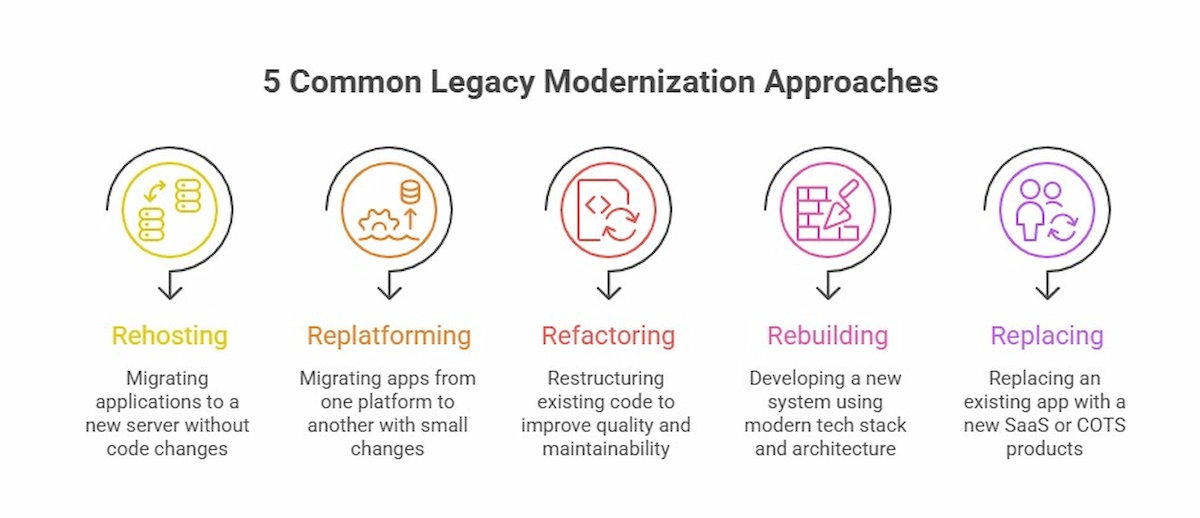
- Rehosting: A strategy for migrating applications from one server to another without changing the code.
- Replatforming: The process of migrating an application or system from one platform to another with small changes to improve performance, cost, or scalability. It is also called lift, tinker, and shift.
- Refactoring: An approach to restructuring existing code to improve its quality, readability, and maintainability without changing the user-facing behavior.
- Rebuilding: A legacy modernization approach where a completely new system is developed using a modern technology stack and architecture. The core business logic is preserved.
- Replacing: A modernization approach where an existing app is replaced with a commercial off-the-shelf (COTS) product, SaaS solution, or custom software.
Understanding legacy application modernization strategies helps businesses choose the right approach and plan more effectively. Leaders can decide which systems need quick fixes, refactoring, or full replacement.
In simple terms, it helps businesses invest wisely, reduce operational risk, improve performance, and support innovation.
How We Evaluated Legacy Modernization Companies
We evaluated the top legacy modernization vendors across seven key factors. Each factor was scored based on how strongly it contributes to a successful modernization project.
The evaluation criteria we considered include:
1. Technology Expertise
We evaluated the expertise of legacy system modernization companies in technologies such as COBOL, VB6, and monolithic systems.
You should also consider its expertise in cloud platforms, its ability to make businesses AI-ready, and how it uses AI tools in its own modernization work.
2. Successful Case Studies
A reliable legacy software modernization company in 2026 should have client case studies and testimonials that prove its expertise.
The case studies should clearly show what the company delivered and the business impact it created. Client testimonials explain how the engagement went.
3. Security and Compliance
Legacy systems often carry security and compliance risks. Those risks can increase during modernization if not handled carefully. That’s why we evaluated each company’s strength in security, compliance, and risk-controlled delivery.
4. Cloud Expertise
Most modernization projects involve cloud migration. Therefore, we evaluated how safely an enterprise legacy modernization partner can migrate applications to the cloud.
We also assessed how the vendor handles key migration challenges, including data loss, downtime, and integration issues.
5. Industry Experience
Legacy software modernization companies in the USA with experience in your industry are often a better choice. They understand industry-specific workflows, challenges, and how to address them effectively.
So, beyond technical expertise, we prioritized legacy modernization partners based on their domain knowledge and experience across a range of industries.
6. Transparent Communication
Clear communication is essential for any legacy modernization project. It becomes even more important when you outsource the project to an offshore company.
We rated companies based on how transparent they are about project progress, pricing, timelines, and potential risks.
7. Post-Modernization Support
Post-modernization support is more important than many businesses realize. Issues can arise after the modernized system goes live.
That’s why we also considered whether legacy modernization service providers offer ongoing support and maintenance to keep operations running smoothly.
| Criteria | Score | Why it Matters | How Businesses Can Verify |
| Technology Expertise | 25 | Ensures the vendor can handle both legacy systems and modern architecture. | Review tech stack experience, solution approach, certifications, and technical team profiles. |
| Successful Case Studies | 20 | Demonstrates that the vendor has delivered similar modernization projects. | Ask for relevant case studies, client references, and project outcomes. |
| Security and Compliance | 15 | Protects sensitive data and reduces legal, operational, and compliance risks. | Check security practices, compliance experience, and data protection methods. |
| Cloud Expertise | 15 | Ensures safe cloud migration with minimal data loss and downtime. | Review cloud partnerships, cloud migration experience, and cloud platforms used. |
| Industry Experience | 10 | Enables the vendor to understand business workflows, risks, and user needs. | Check industry-specific projects, domain knowledge, and regulatory familiarity. |
| Transparent Communication | 8 | Keeps expectations, timelines, costs, and risks clear throughout the project. | Review reporting style, meeting cadence, documentation, and escalation processes. |
| Post-Modernization Support | 7 | Ensures the system remains stable, secure, and scalable after launch. | Confirm SLA terms, monitoring processes, and knowledge transfer practices. |
Top 10 Legacy Software Modernization Companies
Before we get into the list, keep in mind that not every vendor highlighted will be the right fit for your business needs. Your size, budget, industry, and goals all matter.
The legacy system modernization companies below are widely considered the best for their transformation capabilities.
1. IBM
IBM is one of the most established legacy enterprise system modernization firms on our list. It is strongest when modernizing mainframe systems, IBM infrastructure, and other complex enterprise environments.
Clients choose IBM because it helps reduce the risk and uncertainty that come with modernization. Its approach focuses on risk control, compliance, long-term maintainability, and operational resilience.
IBM is a strong fit for large enterprises, banks, government agencies, telecom companies, and businesses with heavy compliance needs. However, it is usually not the best fit for smaller companies, tight budgets, or simple modernization projects.
Best for: Large enterprises, regulated industries, and mainframe modernization.
Core Capabilities
- Mainframe and enterprise system modernization
- Hybrid cloud transformation
- System reengineering
- Security and compliance-focused modernization
Key Information
| Company Information | Details |
| Name | IBM |
| Headquarters | Armonk, New York, USA |
| Founded | 1911 |
| Employees | 300,000+ |
| Website | ibm.com |
2. Code District
Code District is an AI-driven legacy software modernization company that helps growth-stage and mid-market companies upgrade their outdated apps to make them secure, scalable, and AI-ready.
The company follows an incremental modernization approach. It starts by understanding your systems and business requirements, then suggests the most suitable modernization strategy.
Code District has a team of 250+ engineers and has worked on 500+ projects. Its team specializes in modernizing legacy technologies, including COBOL, VB6, and .NET.
Its portfolio includes modernization projects for organizations such as SwatFame, BVC, and Caribbean Airlines. The company has served clients in healthcare, insurance, manufacturing, and the finance industry.
Clients choose Code District for its affordability, flexible engagement models, and proven delivery record.
It might not be the best fit for large enterprise projects that need the scale of Accenture and Deloitte.
Best for: Startups and mid-market companies looking to modernize legacy applications and adopt cloud, automation, and AI capabilities.
Core Capabilities
- Legacy app modernization
- Cloud migration
- AI integration and readiness
- Process automation
Key Information
| Company Information | Details |
| Name | Code District |
| Headquarters | Washington, DC, United States |
| Founded | 2017 |
| Employees | 250+ |
| Website | codedistrict.com |
3. Accenture
Accenture is one of the largest legacy system modernization service providers in 2026. The company serves clients in 120 countries and operates in 52 countries worldwide.
Its services cover cloud migration, DevSecOps, mainframe modernization, and business process transformation.
Clients choose Accenture when modernization is tied to a wider transformation. The company is a strong fit for large enterprises and global organizations that need to modernize multiple systems, teams, and workflows at once.
However, Accenture is not the best fit for smaller companies, simple app rewrites, tight budgets, or projects that only need a lean engineering team.
Best for: Large enterprises that need end-to-end transformation and global delivery support.
Core Capabilities
- Microservices
- Mainframe modernization
- AI-enabled modernization
- Cloud migration
Key Information
| Company Information | Details |
| Name | Accenture |
| Headquarters | Dublin, Ireland |
| Founded | 1989 |
| Employees | 786,000+ |
| Website | accenture.com |
4. Capgemini
Capgemini is a global business and technology transformation company that helps enterprises modernize legacy applications to reduce technical debt and improve agility.
Its services cover application refactoring, cloud migration, mainframe modernization, data modernization, and managed services.
Clients choose Capgemini when the project is complex, highly regulated, or connected to a larger cloud, data, or business transformation program.
The company is a strong fit for highly regulated industries and large enterprises that need to modernize complex application portfolios.
However, it may not be the best fit for startups and mid-market companies with limited budgets and tight timelines.
Best for: Regulated industries and large enterprises upgrading complex legacy systems as part of cloud, data, AI, or business transformation efforts.
Core Capabilities
- Application modernization
- Cloud adoption and migration
- API re-architecture
- Compliance-focused transformation
Key Information
| Company Information | Details |
| Company | Capgemini |
| Headquarters | Paris, France |
| Founded | 1967 |
| Employees | 423,400+ |
| Website | capgemini.com |
5. Cognizant
Cognizant is one of the top legacy modernization companies for enterprises focused on AI readiness, cloud adoption, and core application upgrades.
The company helps businesses assess legacy environments, rationalize platforms, migrate workloads, and modernize applications using different approaches.
The company takes pride in serving regulated industries, including banking, healthcare, insurance, and life sciences.
Clients prefer Cognizant when they need a large IT services partner with industry knowledge, AI-led modernization capability, and global delivery scale.
It may not fit startups and growth-stage companies that prioritize speed of execution over large-scale governance and structure. Cost is another key factor to consider.
Best for: Large enterprises that need a partner experienced in regulated industries and capable of handling large-scale delivery.
Core Capabilities
- AI-led legacy modernization
- Mainframe modernization
- Microservices implementation
- Data modernization
Key Information
| Company Information | Details |
| Name | Cognizant |
| Headquarters | Teaneck, New Jersey, United States |
| Founded | 1994 |
| Employees | 350,000+ |
| Website | cognizant.com |
6. Infosys
Infosys is another big name on our list with a strong portfolio of legacy system modernization. The company can help you with code refactoring, replatforming, and completely rehauling.
Infosys is an ideal choice for enterprises that want to modernize legacy IT landscapes with GenAI, APIs, and platform-led transformation.
Organization partner with Infosys for their mature offshore delivery model, strong process discipline, and enterprise modernization experience.
Infosys projects are typically priced for large enterprises, which may not suit startups or mid-market companies with limited budgets.
Best for: Enterprises that need structured and Gen-AI-assisted modernization.
Core Capabilities
- Mainframe modernization
- Cloud and platform modernization
- API and microservices enablement
- GenAI-assisted modernization
Key Information
| Company Information | Details |
| Name | Infosys |
| Headquarters | Bengaluru, India |
| Founded | 1981 |
| Employees | 320,000+ |
| Website | infosys.com |
7. Tata Consultancy Services (TCS)
TCS is one of the largest legacy software modernization companies for large enterprises that need mainframe modernization and structured transformation at scale.
TCS relies heavily on frameworks, accelerators, and proprietary tools such as TCS MasterCraft to assess, analyze, and modernize legacy systems.
Clients usually prefer TCS when the project is large, operationally sensitive, and tied to enterprise systems that cannot fail.
TCS may not be the first choice if you want a highly customized boutique-style engagement or if your budget is tight.
Best for: Large enterprises modernizing mainframe-heavy or mission-critical systems.
Core Capabilities
- Mainframe modernization
- Legacy application assessment
- Enterprise application modernization
- Managed services and long-term support
Key Information
| Company Information | Details |
| Name | Tata Consultancy Services |
| Headquarters | Mumbai, India |
| Founded | 1968 |
| Employees | 584,000+ |
| Website | tcs.com |
8. Thoughtworks
Thoughtworks is an engineering-led modernization consultancy with a strong focus on helping organizations modernize legacy systems.
The company is known for its incremental modernization approach, AI-supported system understanding, and expertise in transforming critical legacy applications into cloud-native platforms.
Clients choose Thoughtworks for its engineering quality, agile delivery practices, cloud-native architecture expertise, and modern software development capabilities.
Thoughtworks is a strong fit for enterprises looking to reduce legacy risk while improving the way their teams build, deploy, and maintain software.
It may not be the best fit for organizations looking primarily for low-cost staff augmentation, basic lift-and-shift migrations, or large outsourcing-led managed services.
Best for: Enterprises that want high-quality engineering, cloud-native modernization, and agile transformation.
Core Capabilities
- Legacy modernization
- Agile transformation
- Microservices architecture
- Agile engineering transformation
Key Information
| Company Information | Details |
| Name | Thoughtworks |
| Headquarters | Chicago, Illinois, United States |
| Founded | 1993 |
| Employees | 10,000+ |
| Website | thoughtworks.com |
9. Vention
Vention is a software engineering partner focused on legacy application modernization. The company has been in the market for 20+ years and raised $15B+ in client acquisition.
The company helps modernize legacy systems through code improvements, integration of modern technologies, and hands-on engineering execution.
It also supports infrastructure and codebase assessment, along with planning around architecture, cost, ROI, and risk.
Companies choose Vention for flexible engineering teams, faster project kickoffs, and product development support.
It may not be the best fit for large, highly regulated, mainframe-heavy transformation programs.
Best for: Vention is a strong fit for startups and scaleups that need flexible and strong delivery capacity.
Core Capabilities
- Legacy app modernization
- Cloud migration
- Software reengineering
- Enterprise application integration
Key Information
| Company Information | Details |
| Name | Vention |
| Headquarters | New York, New York, United States |
| Founded | 2002 |
| Employees | 1,000+ |
| Website | ventionteams.com |
10. SolGuruz
Founded in 2019, SolGuruz is an AI-assisted custom software development company that specializes in application modernization.
The company helps startups and SMEs modernize legacy systems to improve performance and reduce costs. Its services include system assessment, technology stack upgrades, and performance optimization.
SolGuruz has delivered more than 100 projects and reports an 80% client retention rate.
Companies choose SolGuruz for its product-focused engineering approach and its ability to deliver web, mobile, and modernization projects with flexibility.
It may not be the best fit for large-scale enterprise transformation programs or mainframe-heavy environments.
Best for: Startups, scaleups, and smaller enterprises modernizing applications with cloud, AI, and product engineering support.
Core Capabilities
- Legacy application modernization
- Cloud migration
- Re-engineering and UX refresh
- Web, mobile, and SaaS modernization
Key Information
| Company Information | Details |
| Name | SolGuruz |
| Headquarters | Ahmedabad, Gujarat, India |
| Founded | 2019 |
| Employees | 90+ |
| Website | solguruz.com |
Comparison of the Best Legacy Modernization Service Providers
| Company name | Location | Best fit for | Not fit for |
| IBM | Armonk, New York, USA | Regulated enterprises and mainframes | Small teams or tight budgets |
| Code District | Washington, DC, USA | Startups and mid-market companies needing AI-driven modernization | Large enterprise-scale projects |
| Accenture | Dublin, Ireland | End-to-end global transformation | Simple app rewrites |
| Capgemini | Paris, France | Regulated industries and complex portfolios | Startups or tight timelines |
| Cognizant | Teaneck, New Jersey, USA | Enterprise modernization | Speed-first startups |
| Infosys | Bengaluru, India | GenAI-assisted enterprise modernization | Budget-limited startups |
| TCS | Mumbai, India | Mission-critical mainframe systems | Boutique-style engagements |
| Thoughtworks | Chicago, Illinois, USA | Agile and cloud-native modernization | Low-cost staff augmentation |
| Vention | New York, New York, USA | Startups and scaleups needing flexible teams | Mainframe-heavy programs |
| SolGuruz | Ahmedabad, Gujarat, India | Startups and SMEs modernizing apps | Large enterprise transformation |
Trends and Technologies Shaping Legacy Modernization in 2026
Legacy modernization in 2026 is no longer about replacing everything at once. The smarter approach is to reduce risk, modernize in stages, and improve the systems that still support core business operations.
Several technology trends are shaping how these initiatives are planned and executed.
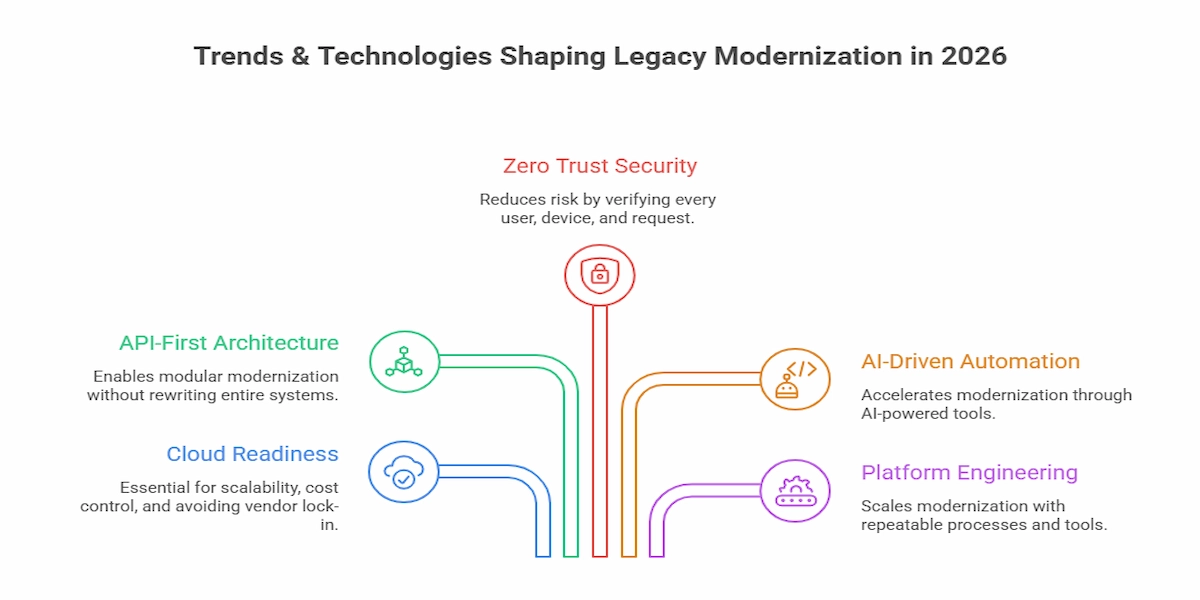
1. Cloud Readiness
Cloud readiness is now the baseline. Companies are preparing legacy workloads for hybrid and multi-cloud environments to scale faster, control costs, and avoid being locked into a single platform.
The key is not “move everything to the cloud.” It is knowing which workloads should move, which should stay, and which need to be redesigned first.
2. API-First and Composable Architecture
API-first architecture helps businesses expose legacy functions without rewriting the entire system.
Combined with composable architecture and Domain-Driven Design, it lets teams modernize one business capability at a time. This lowers disruption and makes future changes easier.
3. Zero Trust Security
Modernization expands the attack surface, especially when systems connect across cloud, on-premises, and third-party platforms. Zero trust reduces that risk by verifying every user, device, and request.
Strong identity and access management, microsegmentation, and security-by-design are now essential parts of modernization planning.
4. AI-Driven Automation
Artificial intelligence is accelerating modernization across the entire software lifecycle. Organizations are using AI-powered tools for code analysis, refactoring, testing, migration planning, and operational monitoring.
These capabilities help teams identify dependencies faster, reduce manual effort, and shorten modernization timelines without sacrificing quality.
5. Platform Engineering and Data Operations
Platform engineering helps modernization scale. DevOps, Infrastructure as Code, CI/CD pipelines, and internal developer platforms give teams repeatable ways to build, test, and deploy changes.
At the same time, data mesh, event-driven systems, and real-time analytics help turn legacy data into usable business insights rather than leaving it trapped in old systems.
In 2026, the success of legacy software modernization comes down to focus. The best legacy system modernization companies do not chase every trend. They choose the technologies that reduce technical debt, strengthen security, and create measurable business value.
Final Notes
Legacy systems increase maintenance costs, create security risks, limit integration, and make it harder to adopt cloud, automation, and AI. Over time, they can slow growth, delay product launches, and reduce operational efficiency.
Legacy system modernization helps businesses reduce technical debt, improve performance, strengthen security, and build systems that are easier to scale and maintain.
Whether the goal is cloud migration, application refactoring, mainframe modernization, or AI readiness, the right partner can reduce risk and simplify the process.
The legacy system modernization companies listed above are a good starting point. Each serves different business needs, budgets, and technical environments. The key is choosing a partner that aligns with your systems, goals, and risk tolerance.
Modernization is easier when it is started early. Waiting too long can turn manageable technical issues into costly operational challenges.
Ready to modernize your legacy systems? Share your requirements with us and let’s discuss what’s possible.
Frequently Asked Questions
What is legacy system modernization, and why is it crucial for enterprise businesses today?
Legacy system modernization is the process of replacing or updating outdated software systems to make them more efficient, secure, and compatible with modern technologies.
Businesses modernize their legacy systems when they become vulnerable to security threats, expensive to maintain, or no longer support business needs and growth.
What are the most effective strategies for modernizing legacy systems?
There is no single legacy modernization strategy that works for every business. The most effective approach depends on your goals, needs, system complexity, risk tolerance, and budget.
You can choose from rehosting, replatforming, refactoring, rebuilding, retaining, or retiring. The best approach is to take an incremental approach to modernization rather than a full system overhaul at once.
How do I know if my organization's legacy systems need modernization?
The following are clear signs your legacy systems need modernization:
- Frequent crashes
- Security and compliance are vulnerable
- High maintenance costs
- Incompatible with modern technologies
- Unable to support business growth
- Not ready for AI, automation, or cloud adoption
- When only a few people know how to maintain the system
How to choose the right legacy modernization partner in the US?
Choosing from hundreds of legacy modernization partners in the US requires evaluating vendors on the following criteria:
- Technical expertise
- Successful case studies
- Domain knowledge
- Experience with different modernization approaches
- Security and compliance expertise
- Communication & collaboration
- Cloud and AI adoption readiness
- Pricing
- Post-modernization support
Which is the best legacy modernization company in 2026?
There is no universal “best” legacy modernization company in 2026. The best vendor for your business depends on your industry, enterprise scale, existing technology stack, and target architecture.
Here are some top legacy system modernization companies based on different business needs:
- Best for startups and mid-market companies: Code District and Vention
- Best for large enterprises and mainframe modernization: Accenture and IBM
- Best for regulated industries: Capgemini
- Best for AI-driven legacy software modernization: Code District
Why should I partner with Code District for legacy system modernization?
Code District is a good choice for mid-market companies because it offers cost-effective legacy modernization solutions.
Code District has a proven track record in app modernization across various industries. The company has modernized systems for clients in professional services, such as Barrett Value Centre, and manufacturing, such as SwatFame.
Its client testimonials and proven business impact have also earned Code District recognition from Clutch as a provider of Top App Modernization Services.
How long does a legacy system modernization project typically take?
Legacy system modernization can take anywhere from 6 months to 12+ months, depending on the modernization approach you choose.
- Rehosting and replatforming: 1 to 3 months
- Refactoring and rearchitecting: 6 to 12 months
- Complete enterprise overhaul: 18 to 36 months
What are the biggest risks of legacy modernization, and how do you avoid them?
The biggest risks of legacy modernization are data loss, downtime, broken integrations, security gaps, scope creep, and business disruption.
Code District starts with a detailed system assessment. We review the codebase, databases, integrations, dependencies, and business workflows before choosing the right modernization approach.
To reduce risk, we use backups, test migrations, implement phased rollouts, maintain rollback plans, and conduct continuous testing. This helps keep critical systems stable while modernization happens in a controlled way.