











On this page_
- Our Evaluation Method for Ranking Cloud Migration Companies in Singapore
- Cloud Migration Companies in Singapore (2026): Best Providers Compared
- Side-by-Side Comparison to Help You Decide
- How to Choose the Right Cloud Migration Company in Singapore: Key Selection Criteria Explained
- Final Thoughts
- Why Code District Is the Right Cloud Migration Partner
Key Takeaways
- Finding the best cloud migration companies in Singapore is harder than it looks, given the number of providers operating across the region.
- Narrow your options by checking cloud platform certifications, PDPA compliance experience, migration methodology, and post-migration support.
- 1CloudHub, Code District, and 1CLOUDSTAR are the top 3 cloud migration companies on this list, based on credentials, delivery track record, and verified data.
- Cloud migration projects in Singapore run from $25,000 to $250,000+, depending on project scope and the number of applications involved.
- AWS and Azure lead the market in Singapore. Check your vendor’s certification tier before you sign anything.
- PDPA compliance is non-negotiable for any migration involving personal data in Singapore.
Your on-premise infrastructure is costing more than it delivers.
Maintenance bills keep rising.
The system cannot scale fast enough, and every quarter that passes makes it harder to justify a migration to leadership.
This is a familiar position for IT Directors across Singapore, where legacy systems are common, and the pressure to modernize is real.
Singapore is Southeast Asia’s primary cloud hub.
AWS, Microsoft Azure, and Google Cloud all run data centers in the region.
The government’s Smart Nation initiative continues to push cloud adoption across the public and private sectors.
Not every cloud migration company in Singapore delivers what it promises, though.
This list covers eight cloud migration companies in Singapore offering cloud migration services across AWS, Azure, and Google Cloud, each evaluated on verified credentials, platform expertise, team size, and documented client work.
Our Evaluation Method for Ranking Cloud Migration Companies in Singapore
Eight vendors made this list. We used six criteria to rank them. The criteria apply to both single-application migrations and enterprise re-architecture projects.
1. Cloud Platform Certifications
Each company’s certification tier was checked against major platforms: AWS Partner Network status, Microsoft Azure Expert MSP designation, and Google Cloud Partner tier.
Certifications confirm that a vendor has met the platform provider’s technical standards.
That is a more reliable signal than self-reported capability claims.
2. PDPA and Compliance Experience
Any cloud migration in Singapore that involves personal data must comply with the Personal Data Protection Act (PDPA).
We looked at whether each company has documented, hands-on experience with PDPA obligations. For companies serving financial clients, we also assessed familiarity with MAS TRM.
3. Migration Methodology
A documented migration process matters more than a polished pitch deck.
A methodology that lives in a slide deck is not a methodology.
We suggested cloud migration companies in Singapore that have a structured and documented process. The 6R framework or something equivalent, covering scoping, planning, execution, testing, and post-migration work.
4. Client and Portfolio Evidence
We went through each company’s documented project history across healthcare, finance, logistics, and manufacturing.
A case study had to name what was migrated, which platforms were involved, and what changed after. Anything that didn’t answer those three questions wasn’t counted.
5. Team Size and Project Capacity
A ten-person firm cannot safely run a 500-application migration.
We matched each vendor’s available capacity against the types of projects they claim to serve.
6. Post-Migration Support
Cloud environments require ongoing monitoring, cost management, and security work after go-live.
We evaluated whether each company offers a defined post-migration managed services tier.
Cloud Migration Companies in Singapore (2026): Best Providers Compared
1. 1CloudHub
1CloudHub is headquartered in Singapore
They specialize in cloud adoption, application modernization, database migration, and data analytics.
They work with clients across media, telecom, manufacturing, retail, and fintech.
1CloudHub runs migrations through a proprietary framework called Nimbus, which structures the process from initial assessment through to post-migration managed services.
The SAP, Oracle, and Microsoft practice handles complex enterprise workloads, which puts the firm within reach of mid-market and larger organizations running legacy ERP environments.
Partnerships span AWS, Azure, GCP, Oracle Cloud, and Alibaba Cloud, with documented migrations across logistics, financial services, and healthcare.
| Quick Company Overview | |
| Location | Singapore |
| Founded | 2018 |
| Company Size | 150+ employees |
| Services | Cloud advisory, cloud migration, managed services, SAP/Oracle/MS practice, DevOps, data analytics |
| Cloud Platforms | AWS, Azure, GCP, Oracle Cloud, Alibaba Cloud |
2. Code District
Code District is a digital transformation consultancy and software development company serving SMBs and mid-market organizations.
The company is based in Washington, D.C. and works with clients across healthcare, finance, insurance, and logistics.
The team starts with AWS or Azure, configures those environments around the client’s requirements, and writes custom code only where off-the-shelf solutions won’t cut it.
That keeps projects moving faster and costs less than starting from scratch.
Working directly with IT directors and operations leads cuts out the middle layer and keeps technical decisions tight.
Past projects include a telehealth platform modernization for Better Healthcare, a data consolidation project for UroGen Pharma, and an AWS-based portal for Capital Good Fund.
| Quick Company Overview | |
| Location | Washington D.C., USA |
| Founded | 2017 |
| Company Size | 200+ |
| Services | App modernization, cloud migration, AI/ML integration, process automation, analytics, and BI |
| Cloud Platforms | AWS, Azure |
3. 1CLOUDSTAR
1CLOUDSTAR has been running cloud migrations out of Singapore since 2013.
The team carries 100+ cloud certifications and has worked with over 2,000 clients across Asia.
Service areas include migration consulting, cloud connectivity via the AWS CloudConnect program, DevOps, cybersecurity, and workload automation.
1CLOUDSTAR’s migration experience includes traditional mainframe legacy systems such as Sun SPARC and VMS environments, through to mobile applications and content management systems.
That depth is worth noting for organizations running older infrastructure that more generalist vendors may not have handled before.
In 2023, the company received the W.Media Global Award for Innovation in Outsourcing, Migration, and Hybrid Strategies, as well as the Golden Bull Award for Outstanding SME.
| Quick Company Overview | |
| Location | Singapore |
| Founded | 2013 |
| Company Size | 11-50 |
| Services | Cloud migration, cloud consulting, managed services, cybersecurity, DevOps, CloudConnect |
| Cloud Platforms | AWS (Direct Connect partner), Azure |
4. Gsoft Cloud
Gsoft Cloud is a Singapore-headquartered cloud services provider founded in 2008.
The company covers cloud migration planning, application modernization, managed cloud infrastructure, DevOps, and cost optimization across AWS, Azure, and GCP.
Gsoft runs nine data centers globally and holds AWS certification.
Documented client work includes a retail telecom cost optimization migration and a SAP B1 migration for an online retail business.
That spread across the enterprise, and SMB work reflects the firm’s range.
With a team of 501 to 1,000 employees, Gsoft has the delivery capacity to handle larger migrations that smaller firms cannot staff without scaling up.
| Quick Company Overview | |
| Location | Singapore |
| Founded | 2007 |
| Company Size | 501-1,000 employees |
| Services | Cloud migration, application modernization, managed cloud, DevOps, cost optimization |
| Cloud Platforms | AWS, Azure, GCP |
5. CloudKeeper
CloudKeeper became an independent entity in 2024 after splitting off from TO THE NEW. It operates as a managed cloud service provider, with a specific focus on migration execution and post-migration cost optimization.
The company helps organizations move workloads to AWS, Azure, and GCP, then stays on as a long-term cost partner through its analytics and reservation management platform.
The company is headquartered in Singapore and focuses on the overlap between cloud migration and FinOps.
CloudKeeper helps organizations plan and execute migrations to AWS, Azure, and GCP, then stays on as a cost optimization partner through its analytics and reservation management platform.
The company holds AWS Premier Consulting Partner status, which is the top tier of the AWS Partner Network, and is recognized by the FinOps Foundation as a Premier Member.
It serves over 400 customers and has delivered more than $100 million in cloud cost savings.
For organizations that want a single vendor to handle both migration and ongoing financial governance of their cloud environment, CloudKeeper covers both under a single engagement.
| Quick Company Overview | |
| Location | Singapore (teams in Singapore, India, USA) |
| Founded | 2009 |
| Company Size | 350+ |
| Services | Cloud migration consulting, FinOps, cost optimization, managed cloud, Well-Architected Reviews |
| Cloud Platforms | AWS, Azure, GCP |
6. CloudMile
CloudMile is an AI solutions provider with headquarters in Taipei and Singapore, and regional offices across Hong Kong, Malaysia, the Philippines, Indonesia, and Vietnam.
Founded in 2017, the company has worked with over 1,400 enterprises across the Asia-Pacific region.
CloudMile supports complex migrations across Google Cloud, AWS, and Azure through a centralized AI-driven orchestration platform.
The team uses automated discovery and dependency-mapping tools to manage the transition of legacy on-premises workloads with minimal disruption to business operations.
Disaster recovery, automated data backup, and FinOps management are included alongside migration services.
With 200+ employees, CloudMile is a better fit for mid-market and large enterprises that need specialized AI-driven technical expertise than for organizations looking for a standard lift-and-shift engagement.
| Quick Company Overview | |
| Location | Singapore |
| Founded | 2017 |
| Company Size | 200+ employees |
| Services | Cloud migration, machine learning, generative AI, data analytics, infrastructure modernization, managed security services |
| Cloud Platforms | Google Cloud (GCP), AWS, Azure |
7. Cloud Kinetics
Cloud Kinetics is an IT services company headquartered in Singapore, founded in 2012.
It operates across cloud migration, data engineering, generative AI, and managed multi-cloud infrastructure.
The company employs over 370+ certified practitioners and runs migrations through its proprietary Arcus platform, which automates and manages complex cloud environments.
A multi-cloud focus across AWS, Google Cloud, and Microsoft Azure means clients are not locked into a single provider.
Specialized experience in data modernization and AI enables organizations to migrate legacy databases to scalable, analytics-ready architectures.
Cloud Kinetics is a practical option for mid-market and enterprise organizations that want to pair a cloud migration with a longer-term operational plan, particularly where FinOps, secure landing zones, or GenAI data work are part of the picture.
| Quick Company Overview | |
| Location | Singapore |
| Founded | 2012 |
| Company Size | 370+ |
| Services | Cloud migration, data engineering, application modernization, managed services (CloudOps), DevOps, and generative AI |
| Cloud Platforms | AWS, Azure, GCP |
8. PointStar
PointStar was founded in 2008 and is headquartered at Ayer Rajah Crescent in Singapore.
The company has grown to 170+ employees across three countries and seven offices, with operations in Singapore, Indonesia, and Malaysia.
PointStar holds a Google Cloud Infrastructure Services Partner Specialization, making it the clear choice on this list for organizations moving primarily to Google Cloud.
Beyond migration, the company offers cloud consulting, data analytics, Oracle NetSuite ERP, Cisco Meraki network infrastructure, backup and disaster recovery, and business process automation.
PointStar has worked with over 3,000 organizations. Documented clients include Krakatau Steel, KFC, and MyRepublic.
The company received institutional backing from the National University of Singapore, which is uncommon among Singapore-native cloud firms of this size.
| Quick Company Overview | |
| Location | Singapore (Ayer Rajah Crescent) |
| Founded | 2008 |
| Company Size | 170+ across 3 countries and 7 offices |
| Services | Cloud migration, cloud consulting, data analytics, ERP (Oracle NetSuite), managed IT, disaster recovery |
| Cloud Platforms | Google Cloud (primary), AWS, Oracle NetSuite |
Side-by-Side Comparison to Help You Decide
| Company | HQ | Founded | Team Size | Best For | Cloud Platforms |
| 1CloudHub | Singapore | 2018 | 150+ | Enterprise migration, SAP/Oracle/MS workloads | AWS, Azure, GCP, Oracle |
| Code District | Washington D.C. | 2017 | 50–200 | SMB and mid-market, app modernization, AI/ML | AWS, Azure |
| 1CLOUDSTAR | Singapore | 2013 | 11–50 | Legacy system migration, hybrid cloud | AWS, Azure |
| Gsoft Cloud | Singapore | 2007 | 500–1,000 | Multi-cloud migration, managed services | AWS, Azure, GCP |
| CloudKeeper | Singapore | 2009 (independent since 2024) | 350+ | Migration + FinOps, cost optimization | AWS, Azure, GCP |
| CloudMile | Singapore | 2017 | 200+ | AI-driven migration, mid-market & enterprise | GCP, AWS, Azure |
| Cloud Kinetics | Singapore | 2012 | 370+ | Multi-cloud, data modernization, GenAI | AWS, Azure, GCP |
| PointStar | Singapore | 2008 | 170+ | Google Cloud migration, ERP | Google Cloud, AWS, Oracle |
How to Choose the Right Cloud Migration Company in Singapore: Key Selection Criteria Explained
1. Define Your Migration Scope
Document what needs to move, what stays on-premise, and what systems the cloud environment must connect with.
Identify which applications are candidates for rehosting, which need re-architecting, and which should be retired.
A vague scope leads to budget overruns and delayed timelines.
Write a prioritized list of applications and data sets before you approach any vendor. Following best practices for cloud migration starts here, with a clear scope document, not with a sales call.
2. Know Your Compliance Requirements
PDPA applies to any migration involving personal data in Singapore.
Work out which data sets contain personal information before the project begins.
Financial services organizations must also comply with MAS TRM guidelines on cloud infrastructure.
Healthcare workloads may entail sector-specific data requirements beyond PDPA. Pin down exactly what applies to your environment before shortlisting anyone.
Ask any vendor you’re seriously considering to walk through their compliance approach upfront.
3. Evaluate Platform Certifications
Look up the vendor’s certification tier on whichever platform you’re actually moving to.
AWS Partner Network tiers, Azure Expert MSP status, and Google Cloud Partner designations are all on public record in each provider’s partner directory.
A strong Azure track record says nothing about AWS depth. Verify the right one.
4. Review Relevant Case Studies
Ask for work samples from your industry and migration type specifically.
Finance, healthcare, and logistics don’t share the same compliance requirements or integration challenges. Work done in one doesn’t automatically carry over to another.
Ask for a reference from a completed project.
5. Clarify Post-Migration Support
Find out whether the contract ends at go-live or continues into a managed services period.
Active monitoring, cost management, and security work don’t stop when the migration does. A vendor that hands off and walks away leaves you to sort that out on your own.
Cloud migration companies in Singapore that do not offer post-migration support leave a gap that you will need to fill internally or with a second vendor.
6. Understand the Pricing Structure
Fixed-fee pricing works well when the scope is fully defined before the project begins.
On the other hand, time-and-materials pricing suits projects where discovery happens during execution.
Either model can work.
The risk is a vendor that cannot clearly explain which model they use or what triggers additional costs. Compare total project costs, not just hourly rates, before making a final decision.
Final Thoughts
Singapore has a range of cloud migration companies working with businesses across healthcare, finance, logistics, and manufacturing.
Smaller firms move faster and are well-suited to SMB and mid-market projects. Larger firms carry more capacity for complex, multi-system enterprise cloud migration programs.
The agencies on this list bring different strengths.
Some focus on specific platforms, others on multi-cloud flexibility, and several add FinOps or AI capabilities alongside the migration. Your choice depends on the project scope, compliance requirements, budget, and the level of post-migration support you need.
Start by defining what a successful migration looks like for your organization. Evaluate cloud migration companies in Singapore based on verified experience in similar work, not marketing claims.
Request detailed proposals, check references, and confirm alignment on compliance and communication before signing.
Why Code District Is the Right Cloud Migration Partner
Code District works with IT directors and operations leaders at SMBs and mid-market companies to move workloads to the cloud without the overhead and risk of large-firm engagements.
The team starts with AWS or Azure, builds the environment around your requirements, and brings in custom code only where it’s genuinely needed.
That keeps timelines shorter and costs lower than a fully bespoke build.
Past projects span healthcare, finance, insurance, and logistics: UroGen Pharma, Better Healthcare, Capital Good Fund, and the Mental Health Association of Maryland.
“There were several needs that I honestly thought would not be possible, but Code District found a way to solve them. The team demonstrated strong project management skills and maintained clear and effective communication throughout.”
Rodney A. Hill, CIO, Mental Health Association of Maryland
Ready to discuss your cloud migration project? Book a free discovery call with the cloud migration experts at Code District.
Frequently Asked Questions
What does cloud migration cost in Singapore?
Cloud migration costs in Singapore typically range from $25,000 for a straightforward lift-and-shift rehosting project to $250,000 or more for a complex re-architecture involving multiple systems, compliance requirements, and post-migration managed services.
The main cost drivers include the number of applications being migrated, the degree of code refactoring required, whether post-migration managed services are included in scope, and compliance work for PDPA or MAS TRM obligations.
Fixed-fee pricing is more common for well-scoped projects where the application inventory is documented before the engagement begins. Time-and-materials pricing applies when discovery happens during execution, and the scope is harder to define upfront.
How long does a cloud migration project take?
A straightforward lift-and-shift migration for a small environment can be completed in four to eight weeks.
Mid-market migrations involving 10 to 50 applications typically run 3 to 6 months, covering assessment, planning, execution, testing, and go-live.
Large enterprise cloud migration projects that involve legacy ERP systems, multi-country data, or significant re-architecture can take twelve months or longer.
What is the difference between AWS and Azure migration in Singapore?
AWS operates its Asia Pacific (Singapore) region from multiple availability zones and has the largest partner ecosystem in Southeast Asia. AWS cloud migration is the most common path for organizations moving workloads that need scalable compute, storage, or machine learning infrastructure.
Microsoft Azure operates its Southeast Asia region from Singapore and is the stronger fit for organizations already running Microsoft workloads, including Windows Server, SQL Server, and Microsoft 365.
Azure cloud migration works well for these environments because licensing portability and hybrid connectivity to on-premise Active Directory are built into the platform.
The right platform depends on your existing technology stack, your licensing agreements, and which platform your vendor holds the deepest certifications on.
What is the 6R framework for cloud migration?
The 6R framework is the standard cloud migration strategy for categorizing how each application should be handled during a migration.
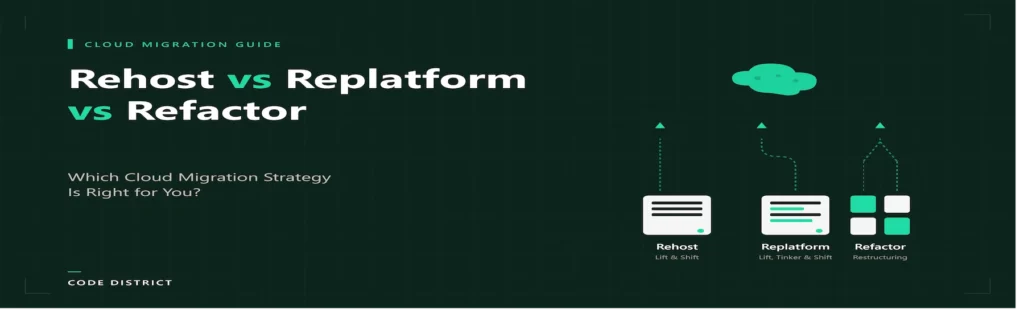
The six strategies are: Rehost (move as-is), Replatform (minor adjustments for cloud), Refactor (re-architect for cloud-native operation), Repurchase (move to a SaaS alternative), Retire (decommission applications no longer needed), and Retain (keep specific workloads on-premise for now).
A credible cloud migration project plan categorizes each application into one of these six options before any migration work begins.
Do cloud migration companies in Singapore handle PDPA compliance?
Reputable cloud migration companies in Singapore build PDPA requirements into the planning process.
This includes data classification, identifying which datasets contain personal information, selecting cloud storage regions that comply with data residency requirements, and confirming that data transfer protocols meet the PDPA’s transfer limitation obligations.
Ask any shortlisted vendor to explain their specific PDPA approach before the project begins.
What is a cloud migration project plan, and do I need one?
A cloud migration project plan is a formal document that defines the scope, application inventory, migration sequence, timeline, resource requirements, risk assessment, rollback procedures, and success criteria for a migration engagement.
Without a documented plan, managing risks, coordinating teams, and diagnosing problems during the migration window becomes significantly harder and more expensive.
Reputable Singapore-based cloud migration companies produce this document during the discovery and planning phase, before any infrastructure work begins.
What are the biggest risks of cloud migration?
The five most common risks in cloud migration projects are:
- Data loss or corruption during migration of large databases or complex file systems, particularly when replication is not verified before cutover.
- Extended downtime that affects revenue and customer experience is most common when migration windows are not tested in a parallel environment first.
- Cost overruns caused by inaccurate pre-migration resource estimates, unexpected egress fees, or scope creep during re-architecture phases.
- Compliance gaps that arise when PDPA or MAS TRM requirements are not built into the migration plan from the start, rather than being addressed after go-live.
- Security misconfigurations in the new cloud environment are common when teams move quickly without a security review at each stage of the migration.
Cloud migration companies in Singapore with a documented risk management plan, defined rollback procedures, and a parallel environment testing phase before cutover mitigate all five of these risks significantly.
How do I migrate to the cloud without downtime?
Zero-downtime migrations use live data replication, phased cutover, and parallel environment testing before the production switch. Agentless cloud migration tools reduce downtime risk by automating replication without requiring changes to the source system.
The approach involves continuously replicating data from the source to the cloud target, running both environments in parallel for a defined period, then switching traffic during a low-usage window.
Agentless migration tools reduce downtime risk by automating replication without requiring changes to the source system.
Ask your cloud migration vendor to explain their specific downtime mitigation approach for your environment type before any work begins.