









On this page_
- Why Choosing the Right Generative AI Development Firm Matters
- Quick Comparison: Best Generative AI Development Companies to Hire in 2026
- Top 10 Generative AI Development Companies to Work With
- What to Look for When Evaluating a Generative AI Company
- How Much Do Generative AI Development Services Cost?
- Final Thoughts: Which Gen AI Development Company is Right for You?
Key Takeaways
- 95% of GenAI projects never reach production due to poor integration and workflow fit. The right partner can help move your project from pilot to production.
- Top generative AI development companies deliver production-ready systems, secure integrations, and measurable efficiency gains across your existing workflows.
- Evaluate any generative AI development firm based on its technical expertise, industry experience, security practices, portfolio depth, and post-launch support.
- Generative AI development services cost range from $10K for pilots to $300K+ for enterprise platforms, depending on scope and complexity.
Organizations can no longer delay adopting generative AI. The longer you wait, the harder it becomes to catch up with competitors already using it.
Across multiple industries, businesses are adopting generative AI to improve productivity and reduce costs. But most projects struggle to move beyond prototypes into production-ready genAI solutions.
An MIT report finds that only 5% of GenAI pilots deliver real business value. Most never scale or justify the cost.
And no, model quality is not the biggest problem here. It’s how well enterprises integrate generative AI into their systems and workflows.
That is where the right generative AI development companies can make a difference.
They integrate generative AI into your existing tools and workflows, delivering production-ready solutions. They also help build AI copilots, RAG-based systems, knowledge assistants, and AI agents.
This guide features companies recognized as leaders for their expertise in generative AI development services. So, if you are a founder or CTO evaluating generative AI development companies, this is a good place to start.
Why Choosing the Right Generative AI Development Firm Matters
The right generative AI development company turns your investment into secure, scalable, production-ready systems. The wrong one can leave you with an AI PoC that looks promising but never scales.
An IBM report on the Cost of Data Breach states that the global average breach cost is $4.4 million, and that 63% of breached organizations lacked AI governance policies. This makes the right partner selection even more crucial.
To keep things simple, here’s a clear side-by-side look at what you can expect from the right GenAI development partner vs. the wrong one.
| What a strong GenAI partner brings | What a weak GenAI partner can cost you |
| A GenAI solution around your use case and workflows | A generic AI tool that doesn’t fit your specific use case |
| Smooth integration with existing tools and systems | A standalone tool that creates more work instead of reducing it |
| Strong security, privacy, and compliance practices | Higher risk of data privacy, security, or compliance issues |
| Reliable AI outputs through testing, guardrails, and monitoring | Inaccurate answers, hallucinations, or unsafe outputs after launch |
| Clear scope, timeline, cost, and success goals | Unclear pricing, delays, and changing expectations |
| Post-launch support and continuous improvement | A one-time handoff with little support when issues appear later |
Quick Comparison: Best Generative AI Development Companies to Hire in 2026
| Company | Founded | Team | Hourly Rate | Clutch Rating | Location | Best For |
| Code District | 2017 | 250 – 999 | $25 – $49 | 4.9 | Washington, DC | Enterprise AI systems, AI agents, RAG systems |
| Netguru | 2008 | 250 – 999 | $50 – $99 | 4.8 | Poznań, Poland | Building AI copilots, chatbots, and customer-facing AI applications |
| Neoteric | 2005 | 50 – 249 | $50 – $99 | 4.9 | Poznan, Poland | AI feasibility, validation, and product strategy |
| LeewayHertz | 2007 | 50 – 249 | $50 – $99 | 4.7 | Gurugram, India | Enterprise AI systems and LLM platforms |
| DataRoot Labs | 2016 | 10 – 49 | $50 – $99 | 4.9 | Kyiv, Ukraine | Advanced AI R&D and custom ML models |
| Reckonsys | 2015 | 50 – 249 | $25 – $49 | 4.8 | Bangalore, India | Startup SaaS products and AI-enabled application development |
| Impressit | 2015 | 50 – 249 | $50 – $99 | 5.0 | London, England | AI features in web and mobile product development |
| Softblues | 2014 | 10 – 49 | $50 – $99 | 5.0 | London, England | Domain-specific AI software |
| Idea Grove | 2005 | 10 – 49 | $150 – $199 | 4.9 | Lewisville, TX | AI-assisted marketing, content, PR workflows |
| Agix Technologies | 2024 | 10 – 49 | < $25 | 5.0 | Boston, USA | Early-stage AI implementation and targeted use cases |
Top 10 Generative AI Development Companies to Work With
1. Code District
Best for: Mid-market companies and enterprises that need generative AI into their existing systems, especially where data, infrastructure, and compliance are complex.
Most generative AI companies add AI as a feature. Code District integrates it into your core systems, data, and business processes. That matters when your stack is aging, your data is fragmented, and compliance is critical.
Their generative AI services include custom LLM integration, Retrieval-Augmented Generation systems, AI chatbot development, and intelligent document processing.
This means they can help build internal knowledge assistants, automate customer support, review large volumes of documents, and add AI features to existing software.
Their engineering scope covers data preparation, model selection, fine-tuning, prompt engineering, and post-deployment monitoring.
Code District also lets you hire generative AI developers to support your internal team.
Code District has deployed 30+ AI solutions in production and delivered over $10M in annual efficiency gains. They have worked with companies like HealthReel, AstraZeneca, Pharmasift, and Nielsen.
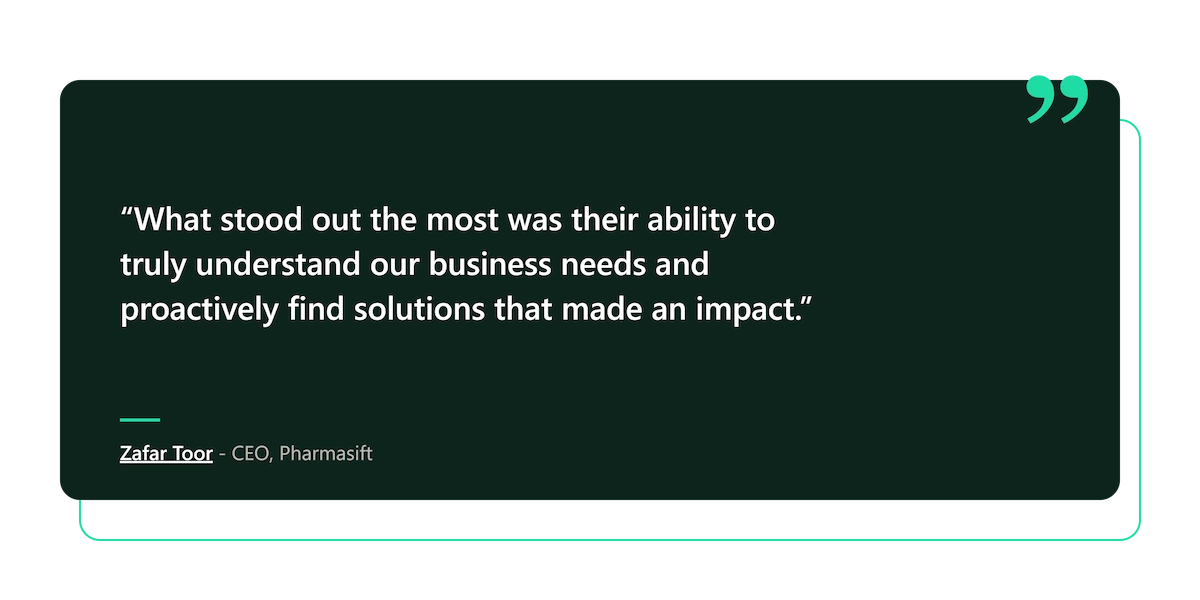
For Pharmasift, they developed a RAG-based compliance platform that improved accuracy and reduced document review time by up to 80%. Read the full Pharmasift case study here.
Here is what the CEO of Pharmasift has to say about their partnership with Code District.
Company Overview
- Location: Washington, DC
- Founded: 2017
- Team: 250-999
- Rate: $25-$49/hr
- Clutch Rating: 4.9
- Website: codedistrict.com
2. Netguru
Best for: Product-led startups and scaleups building customer-facing AI products, copilots, chatbots, or digital platforms.
Netguru approaches generative AI through a product and design lens. They integrate AI into user-facing applications rather than treating it as a backend feature.
Their work includes LLM integration and fine-tuning, RAG pipelines using FAISS and hybrid search, multi-agent system design, and AI agents for workflow automation.
They also built Omega, an internal multi-agent sales workflow system running on o3-mini via Azure OpenAI with AutoGen orchestration, and published the full architecture.
Their strongest industry focus is fintech and digital commerce, with multiple case studies across payments, lending, and banking.
Company Overview
- Location: Poznan, Poland
- Founded: 2008
- Team: 250-999
- Rate: $50-$99/hr
- Clutch Rating: 4.8
- Website: netguru.com
3. Neoteric
Best for: Startups, scaleups, and innovation teams that are still validating whether a GenAI idea is worth building.
Most generative AI development companies on this list focus on building AI systems. Neoteric focuses on use case validation, feasibility, AI readiness assessment, and product strategy.
Their Innovation Funnel identifies viable use cases, runs paid proof-of-concept tests to validate them, and scales only what delivers measurable value.
Their services include custom LLM development, conversational AI, AI product strategy, and readiness workshops covering data, compliance, and security.
Neoteric is the best choice for companies with defined workflows that need clarity on ROI before committing budget.
Company Overview
- Location: Poznan, Poland
- Founded: 2005
- Team: 50-249
- Rate: $50-$99/hr
- Clutch Rating: 4.9
- Website: neoteric.eu
4. LeewayHertz
Best for: Enterprises and large organizations that need GenAI across multiple departments, workflows, and internal systems.
Most enterprise AI projects stall between strategy and execution. LeewayHertz closes that gap by combining advisory and engineering into a single delivery model.
Their differentiator is ZBrain, a low-code orchestration platform for building generative AI applications. It connects multiple LLMs, such as GPT, Claude, Llama, Mistral, and Gemini, as well as vector databases and enterprise systems.
It supports agentic RAG, LLM-powered workflow automation, and AI agents for functions such as legal, HR, and operations.
They have worked with Fortune 500 companies across manufacturing, healthcare, and finance.
Their work includes an AI-powered medical assistant for a healthcare client that processes patient data and supports clinical decision-making.
Company Overview
- Location: Gurugram, India
- Founded: 2007
- Team: 50-249
- Rate: $50-$99/hr
- Clutch Rating: 4.7
- Website: leewayhertz.com
5. DataRoot Labs
Best for: Startups, AI-first companies, and enterprise innovation teams working on technically complex AI, ML, NLP, or data engineering problems.
DataRoot Labs falls among the top generative AI development companies for its research-driven approach.
The company focuses on problems that require custom model development and applied machine learning.
Their capabilities include custom LLM development, RAG architecture, NLP pipelines, computer vision, reinforcement learning, and AI agents.
DataRoot Labs works on projects that involve deep technical implementation rather than lightweight integrations.
Client feedback highlights their technical depth and ability to translate business goals into working solutions.
The company operates with a remote-first delivery model and serves international clients.
Company Overview
- Location: Kyiv, Ukraine
- Founded: 2016
- Team: 10-49
- Rate: $50-$99/hr
- Clutch Rating: 4.9
- Website: datarootlabs.com
6. Reckonsys
Best for: Funded startups, SaaS companies, and product teams that need a full-cycle engineering partner for AI-enabled products.
Reckonsys is a strong fit for companies that need to turn an AI idea into a usable product. Their positioning is more product-focused than model-focused.
They are an ideal partner for startups and SaaS teams building AI-enabled platforms, internal tools, dashboards, or automation products.
Their services include LLM integration, RAG-based knowledge search, agentic workflows, and MLOps for production support.
Reckonsys takes pride in serving industries such as aviation, fintech, healthcare, and logistics.
They are the best option if you need a full-cycle engineering partner rather than standalone AI consulting services.
Company Overview
- Location: Bangalore, India
- Founded: 2015
- Team: 50-249
- Rate: $25-$49/hr
- Clutch Rating: 4.8
- Website: reckonsys.com
7. Impressit
Best for: Startups, scaleups, and established product teams adding AI features to web, mobile, or SaaS applications.
Impressit specializes in developing web and mobile products with integrated AI features.
The company provides custom software development, UI and UX design, and the implementation of generative AI features. Its work spans multiple industries with a focus on building production-ready applications.
They include process discipline with pre-deployment hallucination testing and add a quality layer that most generative AI consulting firms at this price point skip.
Client feedback highlights consistent delivery timelines and responsive communication. Impressit suits product teams building applications that require integrated AI capabilities.
Company Overview
- Location: London, England
- Founded: 2015
- Team: 50-249
- Rate: $50-$99/hr
- Clutch Rating: 5.0
- Website: impressit.io
8. SoftBlues
Best for: Startups, SMEs, and mid-market teams that need focused GenAI applications, MVPs, assistants, or workflow automation tools.
Softblues is a London-based custom generative AI company focused on LLM assistants, chatbots, conversational AI, and workflow automation.
Their case studies span healthcare, fintech, and logistics industries with structured data and strict compliance requirements.
They reference frameworks such as NIST and the EU AI Act in enterprise projects, which indicates awareness of governance and regulatory standards.
Their engagement model includes fixed-scope MVPs and longer-term product partnerships. For teams with a strong domain match, Softblues can be a viable option.
Company Overview
- Location: London, England
- Founded: 2014
- Team: 10-49
- Rate: $50-$99/hr
- Clutch Rating: 5.0
- Website: softblues.io
9. Idea Grove
Best for: B2B technology companies that need AI-assisted PR, content, messaging, and brand visibility.
Idea Grove is different from most generative AI development companies on this list. It is not a traditional engineering partner. It is a B2B PR and communications firm that uses AI to support marketing, content, messaging, SEO, and brand visibility for technology companies.
The company focuses on AI-assisted content creation, media strategy, and brand messaging for technology companies.
Idea Grove uses generative AI to improve communication and content performance. Its work is most relevant for B2B technology, manufacturing, industrial, and supply chain brands.
Idea Grove is worth considering if your goal is AI-assisted marketing and communications.
Company Overview
- Location: Lewisville, TX
- Founded: 2005
- Team: 10-49
- Rate: $150-$199/hr
- Clutch Rating: 4.9
- Website: ideagrove.com
10. Agix Technologies
Best for: Teams with a clearly defined GenAI or agentic AI use case that need focused implementation, workflow automation, or AI systems engineering.
Agix Technologies is a newer entrant focused on generative AI and LLM implementations. Its services include LLM fine-tuning, workflow automation, and custom generative AI applications.
It can be a suitable option for teams that need a focused AI implementation without the cost or complexity of a larger enterprise engagement.
Because the company is still building its public track record, it is better suited for contained use cases than complex multi-system enterprise deployments.
Teams evaluating Agix should ask for client references, examples of production deployments, and details on how they handle security, integration, testing, and post-launch support.
Company Overview
- Founded: 2024
- Team: 10-49
- Rate: <$25/hr
- Clutch Rating: 5.0
- Location: Boston, MA
- Website: agixtech.com
What to Look for When Evaluating a Generative AI Company
You have identified a business problem and know that generative AI can help. But can you trust just any firm? Not the best idea.
Choosing the wrong partner can cost you time, budget, and resources, and still leave you with a solution that never moves beyond the pilot stage.
That is why we created this checklist based on our experience and the common concerns buyers raise when evaluating potential partners.
1. Technical expertise
Technical expertise should be the first thing to consider when choosing the best generative AI companies. Evaluate their expertise with LLM models, RAG architectures, AI agents, model fine-tuning, data engineering, and responsible AI practices.
2. Portfolio and client references
Most generative AI development companies make similar promises on their websites. Don’t buy into those promises.
Look at the work they have delivered for clients and read their testimonials. It will hint at the technologies they have used, the outcomes they have achieved, and what their customers think about partnering with them.
3. Industry experience
Industry experience matters just as much as any other factor on the checklist. A generative AI software development company with experience in your industry already knows the workflows, edge cases, high-impact use cases, and compliance requirements. That understanding can directly contribute to the project’s success.
4. Data security and compliance
Data security and compliance are major concerns with AI systems. One small mistake can put your business at legal, financial, and reputational risk.
Make sure your development partner follows strict security protocols, uses Explainable AI techniques, and complies with relevant regulations such as HIPAA and GDPR.
5. Pricing
The cost of generative AI development varies based on the project scope, complexity, and the partner you choose.
Evaluate what each service provider includes in the price, such as strategy, integrations, security, and post-launch support. Don’t jump on the cheapest option, but the one that delivers the best value.
How Much Do Generative AI Development Services Cost?
It depends. The cost of generative AI development services depends on the scope, model choice, customization, integration, and operational requirements.
Pricing also varies by partner, since every generative AI development firm has its own pricing model, team structure, and level of expertise.
In short, there is no fixed price. But, to help you estimate your investment, here is a rough cost breakdown based on the project size and complexity:
- Prototype or small pilots = $10,000 to $50,000
A sandbox version for one defined business problem to test GenAI feasibility, model fit, and basic integration.
- Mid-size projects = $50,000 to $200,000
Covers custom generative AI solution, workflow automation, secure architecture, user-oriented interfaces, and deployment support.
- Enterprise-level platform = $300,000+
Usually includes multiple AI use cases, multi-system integrations, stronger security controls, industry-specific compliance, analytics and monitoring, team training, and long-term support across the organization.
Now that you have a general idea of the pricing ranges, you can see where your project may fit. However, the final cost will depend on the specific project details, variables involved, and the partner you choose.
Need a cost estimate for your generative AI project? Share your requirements with our experts, and our team will help you assess the scope, complexity, and expected investment.
Final Thoughts: Which Gen AI Development Company is Right for You?
The top generative AI development companies highlighted above have the expertise, experience, proven track record, and industry-specific capabilities needed to support different business requirements.
If your team is spending too much time on repetitive tasks, struggling to make faster decisions, or delivering a poor customer experience, the GenAI development companies on this list are a good starting point.
However, it is important to evaluate other available options based on your use case, data readiness, compliance needs, and growth plans.
Many teams know generative AI can help, but they struggle to turn that interest into something useful for the business. The challenge is usually not the idea. It is knowing which use case is worth building and how to make it work in real workflows.
Code District helps you find that starting point and build a GenAI solution that solves a clear business problem. Share your requirements to discuss what makes sense for your team.
Frequently Asked Questions
What is a generative AI development company?
A generative AI development company helps businesses design and build custom AI solutions using GenAI models such as Gemini, Mistral, Llama, and GPT.
These AI systems include, but are not limited to:
- AI copilots
- AI agents
- Intelligent chatbots
- Content generation tools
- Recommendation engines
These generative AI solutions generate content, such as texts, images, videos, code, and structured data, to help organizations automate tasks, support better decision-making, and improve the customer experience.
What services do generative AI development companies provide?
Generative AI development companies provide end-to-end services, including generative AI consulting, data analysis, custom AI model development, model fine-tuning, retrieval-augmented generation (RAG) implementation, AI agent development, LLM integration, workflow automation, and ongoing support and maintenance.
How to choose the right generative AI development company?
Choosing the right generative AI development company starts with understanding your business needs and goals. Once these requirements are clear, you can evaluate potential generative AI development companies on the following key factors:
- Years of experience
- Technical expertise
- Industry-specific experience
- Security and compliance practices
- Scalability of solutions
- Successful client case studies
- Client testimonials and reviews
- Pricing and budget fit
Which generative AI companies are best for enterprise use in 2026?
The widely used generative AI model providers for enterprise use in 2026 include:
- OpenAI
- Anthropic
- Google Gemini
- Mistral AI
These companies provide the AI models and platforms businesses use to build AI copilots, conversational chatbots, and knowledge assistants.
To integrate these AI models in business apps and build custom solutions, enterprises partner with generative AI development companies such as Code District.
Which industries are seeing the fastest ROI from generative AI?
Technology, fintech, telecom, healthcare, and retail are seeing the fastest ROI from generative AI. These industries benefit quickly by using GenAI to automate high-volume tasks such as coding, customer support, fraud detection, and marketing.
What makes Code District one of the top trusted generative AI development companies?
Code District ranks among the top generative AI development companies for its proven experience, technical expertise, security practices, and cost-effective pricing.
Its portfolio includes generative AI projects such as PharmaSift and HealthReel. Clients describe Code District as communicative, timely, professional, flexible, and committed to high-quality delivery.
Together, these qualities make Code District a reliable GenAI for mid-market companies and enterprises.