











On this page_
- The RPA Landscape in 2026: Rise of Agentic Automation
- Detailed Comparison: Top Robotic Process Automation Companies
- RPA Vendors Comparison: Quick Side-by-Side Overview
- RPA Platform vs. Service Provider: Which One Do You Need?
-
How to Evaluate Robotic Process Automation Vendors
- 1. Platform Expertise
- 2. Industry and Process Experience
- 3. Process Discovery and Automation Fit
- 4. Integration With Existing Systems
- 5. Intelligent Automation Capabilities
- 6. Security, Governance, and Scalability
- 7. Support Model and SLAs
- 8. Pricing and Proof of Value
- Quick Checklist to Evaluate Top RPA Companies in the USA
- Bottom Line
Key Takeaways
- Robotic process automation (RPA) becomes necessary when repetitive tasks, manual data entry, disconnected systems, delays, or compliance gaps slow down operations.
- The RPA market is shifting toward intelligent automation, where AI-powered bots support process discovery, document processing, and workflow orchestration.
- Choose an RPA platform if you have an in-house automation team; choose an RPA service provider for implementation, integration, and support.
- Evaluate RPA service providers based on platform expertise, industry experience, integration capabilities, security, governance, SLAs, and measurable ROI.
- The right RPA partner should automate workflows, improve process visibility, modernize legacy systems, and support scalable enterprise automation.
Rising costs, simple tasks taking hours, frustrated customers, and compliance concerns. Do these challenges sound familiar?
These are not random problems. They are signs of operational inefficiency stemming from repetitive tasks, excessive manual work, and disconnected systems.
In such situations, automation is no longer a “nice to have” and becomes a business priority. That is when CTOs and operations leaders start looking for the top robotic process automation companies to fix these issues.
But that urgency can also lead teams to rush the decision. There are hundreds of RPA companies out there, but not every provider is the right fit for your use case, budget, or long-term goals.
To make your search easier, we researched and curated a list of the 10 best RPA companies in 2026. For each one, we break down what they do best, who they are best suited for, and which use cases they are strongest in.
Our Recommended RPA Companies
-

Best for: Enterprise-wide automation with strong governance, compliance, and orchestration.
Strongest Industry Fit: Banking & finance, public sector, supply chain -

Best for: Custom RPA implementation and workflow automation for mid-market and growing companies.
Strongest Industry Fit: Healthcare, manufacturing, insurance, logistics -

Best for: Enterprises needing cloud-native RPA, process discovery, document automation, and shared services.
Strongest Industry Fit: Financial services, retail, life sciences, telecom

The RPA Landscape in 2026: Rise of Agentic Automation
Before we get into the detailed list, it is worth looking at how the RPA landscape is changing in 2026. The global robotic process automation market was valued at US$4.0 billion in 2025 and is projected to reach US$13.1 billion by 2032.
The reason for that growth is clear. Businesses are under pressure to do more with leaner teams, fewer delays, and tighter controls.
RPA helps companies:
- Reduce Employee Burnout: RPA takes repetitive manual work off employees’ plates to give teams more time for work that requires judgment, creativity, and problem-solving.
- Improve Customer Experience: By accelerating customer-facing workflows, RPA reduces delays and delivers a smoother customer experience.
- Strengthen Compliance: RPA systems can enhance compliance by consistently applying rules and ensuring every action is traceable.
But the next wave of robotic process automation looks very different.
For years, RPA was known for automating repetitive, rule-based tasks. As we head toward mid-2026, that is starting to change. The market is shifting toward AI-powered and agentic automation, in which systems are becoming more goal-oriented, context-aware, and adaptable to workflow changes.
That shift is turning RPA from basic task automation into a more intelligent layer of business operations.
With that context in mind, let’s get into our top picks and compare the top RPA companies in 2026.
Detailed Comparison: Top Robotic Process Automation Companies
This robotic process automation companies list includes both RPA platform vendors and RPA implementation partners. Some companies sell the software used to build bots, while others help businesses design, develop, integrate, and maintain automation workflows.
Use the list below to compare each company by industry fit, use case fit, and key buying details.
1. UiPath
UiPath falls among the RPA market leaders for enterprise automation. The company was founded in Romania in 2005 and is headquartered at One Vanderbilt Avenue in New York City.
Its platform supports the full automation lifecycle, including bot development, bot management, process mining, testing, governance, and intelligent document processing.
In March 2025, UiPath acquired Peak AI to strengthen its AI and ML capabilities.
UiPath is a good choice for large organizations looking to build and manage automation at scale. They make it to our list of the best RPA companies because their platform offers the security, governance, and advanced automation capabilities that enterprise teams often need.
Best industry fit:
Banking, insurance, public sector, retail, logistics, BPO, and large enterprise operations.
Ideal use case:
Best for enterprise workflow orchestration, process mining, claims processing, compliance workflows, unattended bots, and automation programs that need strong governance.
Key Information:
- Founded: 2005
- Location: New York, NY, USA
2. Code District
Code District is an AI transformation company that can help you with intelligent process automation, RAG-based systems, and legacy application modernization.
Code District holds ISO 27001 and ISO 9001 certifications, which reflect a strong focus on security, quality, and reliable delivery. They’ve also been recognized on platforms like GoodFirms and Clutch for their AI and automation services.
Code District made this list because of their hands-on experience with workflow automation. It is visible in their work, especially projects like Swatfame and BVC, where they modernized legacy systems and tied automation directly to measurable business outcomes.
Best industry fit:
Healthcare, insurance, enterprise operations, logistics, and mid-market companies modernizing internal systems.
Ideal use case:
Best for workflow automation, AI-focused business process automation, legacy system modernization, customer service automation, and internal portals.
Key Information:
- Founded: 2017
- Location: Washington, D.C., USA
3. Automation Anywhere
Automation Anywhere is one of the most recognized and largest RPA companies for enterprise-grade automation programs. Founded in 2003, the company acquired Aisera in November 2025, adding autonomous enterprise capabilities to its Automation 360 platform.
The platform also supports attended bots, unattended bots, process discovery, and process orchestration.
Automation Anywhere is best suited for enterprises that want to build a scalable digital workforce across departments rather than to automate a single isolated task.
Best industry fit:
Financial services, telecom, technology, customer service, shared services, and large enterprise operations.
Ideal use case:
Best for enterprise bot programs, invoice automation, high-volume data entry, document processing, and large-scale enterprise automation.
Key Information:
- Location: San Jose, CA, USA
- Founded: Automation 360
4. Vidi Corp LTD
Vidi Corp LTD is a UK-based automation and data consultancy with offices in Oxford and London.
The company is a strong fit for businesses that already use Microsoft tools and want to automate workflows with Power Automate, Power Apps, and Power BI.
Vidi Corp also provides analytics and reporting that help improve both automation performance and process visibility. It belongs on this list because it combines process automation, business intelligence, and Microsoft Power Platform consulting.
Best industry fit:
Small and mid-sized businesses, finance teams, and companies using Microsoft Power Platform.
Ideal use case:
Best for Power Automate workflows, internal approval flows, reporting automation, data extraction, and Power BI dashboards.
Key Information:
- Founded: 2021
- Location: Oxford, UK (also London, UK)
5. Itransition
Itransition is a software engineering and IT consulting company focused on robotic process automation for the healthcare, banking, and automotive industries. The company employs 3,000+ specialists and has delivered 1,600+ projects for 800+ clients across 40+ countries.
Itransition implements RPA using UiPath and Microsoft Power Automate, covering consulting, bot development, platform migration, and managed services.
The company deserves a place on our vetted list because it combines RPA delivery with broader software engineering depth.
Best industry fit:
Enterprises in the banking, automotive, healthcare, logistics, and real estate sectors.
Ideal use case:
Best for RPA consulting, process improvement, ledger updates, stock level tracking, and customer feedback collection and summarization.
Key Information:
- Founded: 1998
- Location: Decatur, GA, USA
6. Cognizant
Cognizant is one of the largest professional services companies in the world and a strong choice for enterprise buyers that need automation, consulting, and managed operations in one engagement.
Their RPA services include robotic desktop automation (RDA), attended and unattended bots, and automation solutions integrated with business process outsourcing operations.
Cognizant is a better fit for complex enterprise automation, managed services, and operational efficiency at a global scale.
Best industry fit:
Insurance, life sciences, telecom, pension administration, and large enterprise operations.
Ideal use case:
Best for BPO-integrated RPA, back-office automation, customer operations, service desk workflows, and large managed automation programs.
Key Information:
- Founded: 1994
- Location: Teaneck, NJ, USA
7. Pega
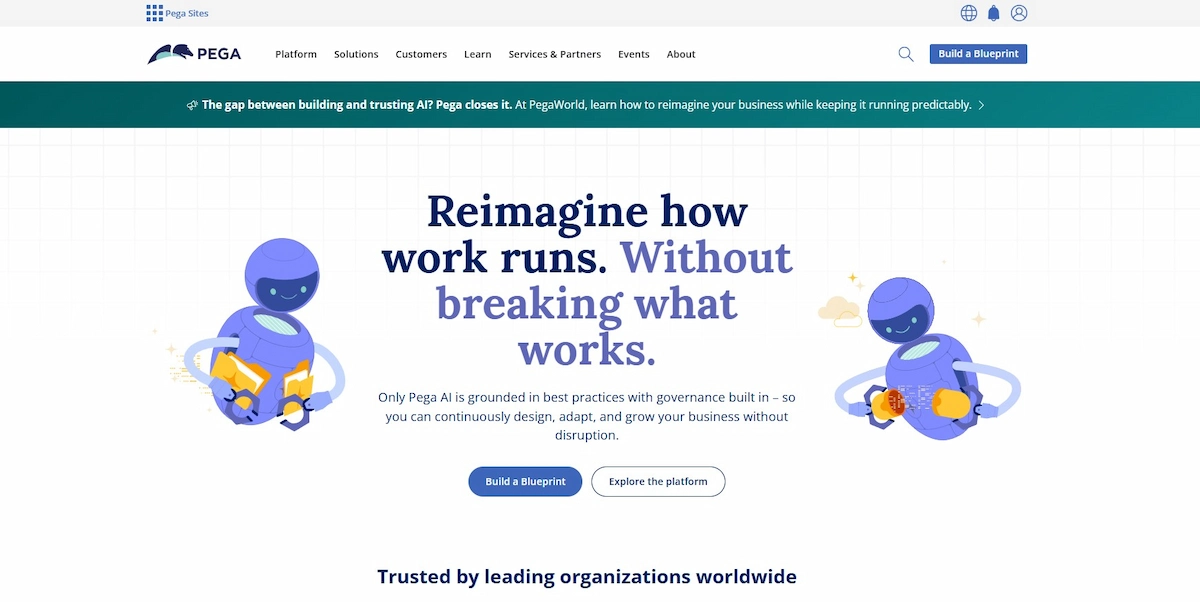
Pega is a major enterprise software company founded in 1983 by CEO Alan Trefler and based in Waltham, Massachusetts.
The company is known for workflow automation, case management, CRM, AI decisioning, and RPA.
Its platform is useful when businesses need automation tied to customer journeys, business rules, approvals, and real-time decisions.
Pega is especially strong for complex, regulated environments where workflow logic, decision management, and compliance matter.
Best industry fit:
Financial services, healthcare, government, telecom, and customer service-heavy enterprises.
Ideal use case:
Best for customer service automation, case management, real-time decisioning, compliance-heavy processes, and digital workflow transformation.
Key Information:
- Founded: 1983
- Location: Waltham, MA, USA
8. Appian
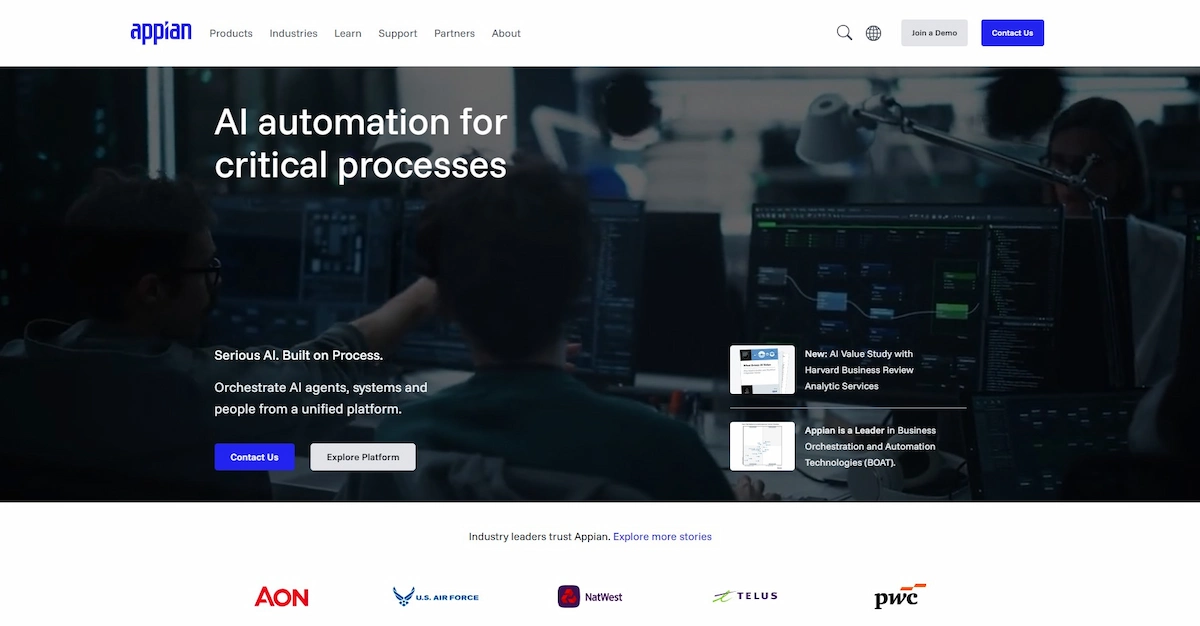
Appian is a low-code process automation platform built for complex enterprise workflows. The Appian Platform integrates low-code development, RPA, process mining, AI automation, data fabric, and case management in a single environment.
Appian is a strong fit for businesses that want automation to connect people, systems, data, and decisions in a single environment.
Appian belongs on this list as it holds Gartner Magic Quadrant Leader recognition for Enterprise Low-Code Application Platforms and Business Orchestration and Automation Technologies (2025).
Best industry fit:
Government, insurance, healthcare, life sciences, manufacturing, and enterprise operations.
Ideal use case:
Best for case management, onboarding, service request automation, complex approvals, document processing, process orchestration, and AI-assisted enterprise workflows.
Key Information:
- Founded: 1999
- Location: McLean, VA, USA
9. UDS Systems
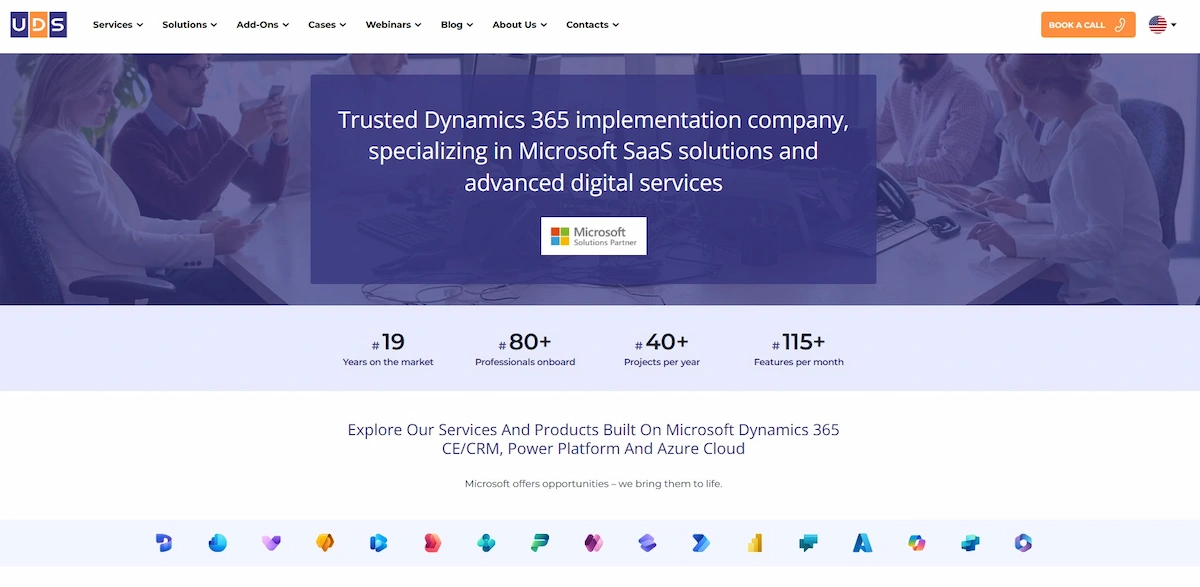
UDS Systems is a Microsoft-focused implementation firm that works with Dynamics 365, Power Platform, and Azure.
The company has completed 70+ projects for enterprise clients in the EU and the US, serving companies with mid-market and large enterprises.
UDS Systems is a strong fit for businesses that want RPA to sit within a broader Microsoft ecosystem rather than using standalone bots. Its work is especially useful when automation needs to connect with CRM workflows, approvals, finance operations, or internal business applications.
Best industry fit:
Companies using Microsoft Dynamics 365, Azure, CRM-heavy operations, HR, fleet management, and enterprise operations.
Ideal use case:
Best for approval routing, CRM updates, employee workflows, finance automation, and end-to-end processes across Microsoft systems.
Key Information:
- Location: Kyiv, Ukraine, with offices in Germany and Finland
- Founded: 2007
10. SolveJet
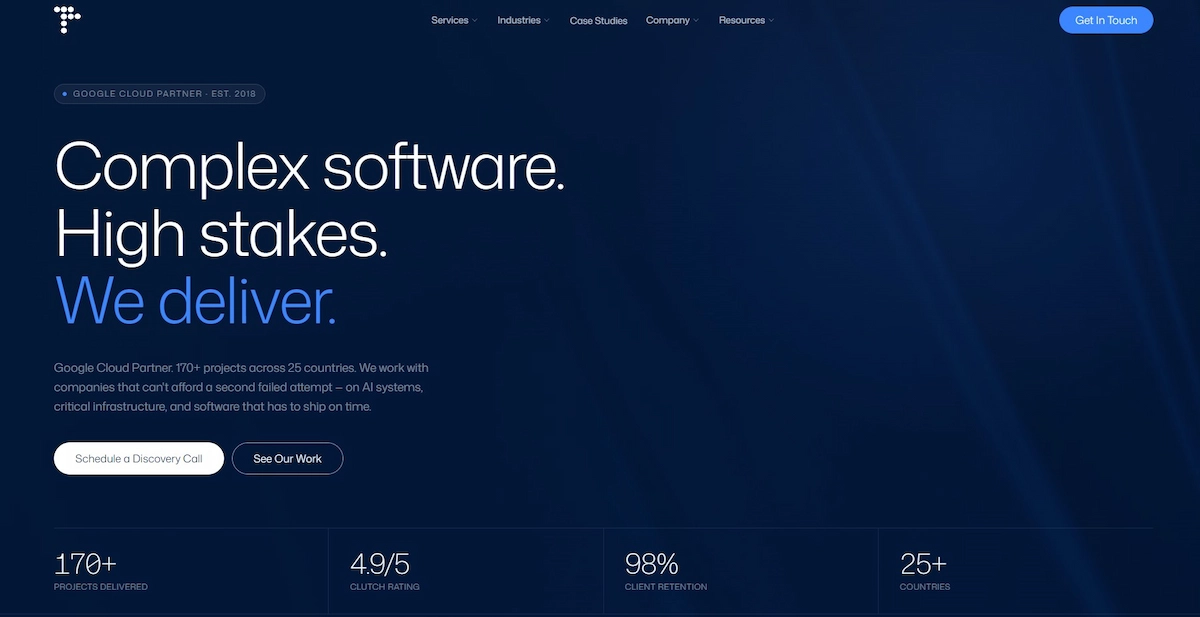
SolveJet is a custom software and cloud engineering company operating in the US and India. The company holds ISO 27001:2022 certification and is a Google Cloud Partner.
It has delivered projects for more than 50 clients across staff augmentation, app development, SaaS development, and custom software development.
Its RPA work is part of broader digital transformation initiatives. Instead of deploying standalone bot pipelines, the company integrates automation capabilities into custom-built platforms or SaaS products.
Best industry fit:
SaaS companies, startups, mid-market businesses, cloud-first teams, and businesses building custom internal platforms.
Ideal use case:
Best for SaaS workflow automation, internal tool automation, custom dashboards, data creation, and automation inside business applications.
Key Information:
- Founded: 2018
- Location: USA and India
RPA Vendors Comparison: Quick Side-by-Side Overview
| Company | Best For | Best Industries | Key Strengths |
| UiPath | Large enterprises with internal automation and governance needs | Banking, insurance, public sector, retail, logistics, BPO | Enterprise automation, process mining, workflow orchestration, unattended bots, governance |
| Code District | Mid-market and growing companies modernizing internal systems | Healthcare, insurance, logistics, enterprise operations | RPA implementation, workflow automation, AI transformation, legacy modernization, internal portals |
| Automation Anywhere | Large enterprises building automation across departments | Financial services, telecom, technology, customer service, shared services | Cloud-native RPA, attended and unattended bots, process discovery, document processing |
| Vidi Corp LTD | Small and mid-sized businesses using Microsoft tools | Finance teams, SMBs, Microsoft Power Platform users | Power Automate workflows, Power BI dashboards, reporting automation, data extraction |
| Itransition | Mid-market and enterprise companies needing engineering depth | Banking, automotive, healthcare, logistics, real estate | RPA consulting, bot development, process improvement, platform migration, managed services |
| Cognizant | Large enterprises needing automation with managed operations | Insurance, life sciences, telecom, pension administration | BPO-integrated RPA, back-office automation, customer operations, managed automation programs |
| Pega | Regulated enterprises with complex workflow and decision needs | Financial services, healthcare, government, telecom, customer service | Case management, AI decisioning, compliance workflows, customer service automation |
| Appian | Enterprises connecting people, systems, data, and decisions | Government, insurance, healthcare, life sciences, manufacturing | Low-code automation, process mining, case management, workflow orchestration, document processing |
| UDS Systems | Mid-market and large enterprises using Microsoft ecosystems | CRM-heavy operations, HR, fleet management, enterprise operations | Dynamics 365 automation, approval routing, CRM updates, finance workflows |
| SolveJet | Startups, SaaS companies, and cloud-first mid-market teams | SaaS, startups, product companies, custom internal platforms | SaaS workflow automation, internal tool automation, custom dashboards, cloud integrations |
RPA Platform vs. Service Provider: Which One Do You Need?
The decision between an RPA platform and service provider comes down to who will own the automation effort.
If you have the time, technical resources, and internal expertise, an RPA platform gives your team the tools to build and manage automations on your own.
Contrarily, an RPA services company is a viable choice if you don’t have a dedicated automation team. They can handle everything from identifying opportunities and building workflows to deployment, integrations, and ongoing support.
| Factor | RPA Platform | RPA Service Provider |
| What it is | Software used to build, run, and manage RPA bots | A company that builds, deploys, and supports RPA solutions |
| Best for | Companies with internal automation, IT, or process teams | Companies without in-house RPA expertise or enough developer capacity |
| What you get | Licenses, bot-building tools, dashboards, governance features, and platform support | Process discovery, bot development, integrations, testing, deployment, and maintenance |
| Pricing model | Subscription, usage-based, or seat-based licensing | Project-based or time-and-materials hourly rates |
| Integration work | Your team handles connections with CRMs, ERPs, APIs, databases, and legacy systems | The provider handles integration planning and implementation |
| AI readiness | Depends on the platform’s built-in features, such as process mining, document processing, analytics, or AI agents | Depends on the provider’s experience with intelligent automation and AI |
| Support model | Platform support, documentation, community forums, and partner referrals | Direct project support, SLAs, managed services, and hypercare after launch |
| Main advantage | More control and better long-term scalability if you have the right team | Faster execution and less internal hiring or training required |
| Main risk | Requires internal skills, governance, and ongoing ownership | Can create vendor dependency if knowledge transfer |
Quick Decision Checklist
You should choose an RPA platform if you:
- Have an internal automation or IT team
- Want more control over bot development
- Plan to scale automation across departments
- Can manage governance, security, and maintenance in-house
- Want lower long-term costs after setup
It is good to choose an RPA service provider if you:
- Do not have in-house RPA expertise
- Need faster implementation
- Want help choosing the right automation use cases
- Need support with CRMs, ERPs, APIs, and legacy systems
- Want ongoing bot monitoring, maintenance, and support
How to Evaluate Robotic Process Automation Vendors
The highlighted top RPA companies on our list are not the only providers available. The purpose of the list is to be a good starting point for you to compare credible options.
You should do your due diligence and choose an RPA company that aligns with your automation goals, process complexity, budget, and long-term support needs.
If you are evaluating RPA service providers for the first time, knowing what to look for can be confusing. The criteria below will help you compare and choose the one that best fits your business.
1. Platform Expertise
Check whether the provider has hands-on experience with leading RPA platforms, including UiPath, Automation Anywhere, and SS&C Blue Prism.
Leading RPA companies should understand platform setup, bot development, testing, deployment, and production monitoring. If your business needs more than basic bots, also ask whether they can help you with Low-code or No-code automation.
2. Industry and Process Experience
Look for RPA service providers that have worked on workflows similar to yours. If you want to automate HR workflows, look for experience automating employee onboarding or performance review processes. If you’re focused on customer service, you may want to see their work with ticket routing, order status updates, and refund requests.
Industry and workflow automation experience helps firms understand common exceptions, compliance needs, and system dependencies faster.
3. Process Discovery and Automation Fit
The top robotic process automation companies don’t automate every task. They assess whether the process is stable, repetitive, rule-based, and worth automating.
This includes reviewing process discovery, exception frequency, manual handoffs, data quality, and dependency on human judgment.
4. Integration With Existing Systems
Since RPA usually connects multiple systems, from CRMs and ERPs to spreadsheets, APIs, databases, and legacy tools, you should ask each RPA industry leader how they manage integrations, access permissions, and system changes.
5. Intelligent Automation Capabilities
If your goal goes beyond traditional bots and toward enterprise automation, evaluate whether the top robotic process automation companies in the USA can support intelligent automation capabilities such as document processing, data extraction, analytics, and workflow orchestration.
6. Security, Governance, and Scalability
RPA bots often handle sensitive business data, so security should not be treated as an afterthought.
Before choosing a provider, check how they manage role-based access, audit logs, data protection, and change control. Strong governance becomes even more important as you scale from a few automations to a larger digital workforce with both attended and unattended bots.
7. Support Model and SLAs
Bots need support after deployment. They can fail when login flows change, APIs update, or business rules shift.
Hire an RPA company that offers ongoing support and maintenance, including bot monitoring, issue resolution, and performance checks. A reliable provider should also define support terms, response times, ownership, and service-level agreements before the project starts.
8. Pricing and Proof of Value
Do not compare the best RPA companies only by the initial development quote. Review the full cost, including discovery, development, licensing, support, and future scaling.
Also, ask for case studies with clear metrics, such as productivity gains, improvements in customer engagement, time saved, error reduction, and overall impact on business growth.
Quick Checklist to Evaluate Top RPA Companies in the USA
Choose the robotic process automation service provider that can prove it has:
- Certified platform expertise
- Experience with similar workflows and industries
- A clear process discovery method
- Strong integration experience with modern tools and legacy systems
- Support for RPA, intelligent automation, and workflow orchestration
- Clear security, governance, and scalability practices
- Reliable post-deployment support and SLAs
- Transparent pricing and measurable ROI
The best RPA vendor should help you automate the right processes, reduce manual tasks, improve process visibility, and build automation that can scale with your business.
Bottom Line
The best RPA company is not always the biggest platform vendor or the most recognizable name. The right choice depends on your automation goals, workflow complexity, system integrations, and the level of support your team needs after deployment.
If you already have an internal automation team, a platform may give you more control. But if you need help with process discovery, bot development, integrations, testing, deployment, and maintenance, an RPA implementation partner is the right choice.
When choosing top robotic process automation companies, businesses should consider industry experience, platform expertise, integration capabilities, pricing, and security practices.
Need an RPA implementation partner? Code District helps mid-market and growing companies automate workflows, modernize legacy systems, and integrate disconnected apps using UiPath, Microsoft Power Platform, APIs, and other automation platforms.
Contact Code District to share your automation goals and see which workflows are actually worth automating first.
Frequently Asked Questions
What is RPA and how does it work?
Robotic process automation, or RPA, uses software bots to automate repetitive, rule-based tasks. These bots follow set steps to fill out forms, update records, process documents, send emails, and trigger workflows across business systems.
Modern RPA can also use AI to read documents, understand context, and support more complex automation.
Which company is the market leader in RPA?
UiPath is widely considered one of the leading RPA companies, especially for enterprise automation. Automation Anywhere and SS&C Blue Prism are also market leaders.
The right choice depends on your company size, automation goals, integration needs, governance requirements, and whether you need a platform, an implementation partner, or both.
What is the best RPA software for enterprises?
UiPath is a top choice for enterprises that need scalable automation, governance, orchestration, process mining, and AI-powered workflows.
Automation Anywhere is also strong for cloud-native automation, document processing, and high-volume enterprise processes. Regulated companies may also consider SS&C Blue Prism for secure and governed automation.
Which industries use RPA solutions the most?
RPA is most commonly used in industries with high-volume, repetitive, document-heavy, and compliance-driven processes.
The most common industries include:
- Banking and financial services
- Insurance
- Healthcare
- Manufacturing
- Telecom
- Retail and e-commerce
- Logistics and supply chain
- Public sector
Common use cases include claims processing, invoice automation, onboarding, reporting, data entry, HR workflows, and customer service automation.
What should businesses look for in an RPA vendor?
Businesses should look for an RPA vendor that fits their use case, systems, budget, and long-term automation goals.
Some of the key factors to evaluate include:
- Platform maturity
- Implementation support
- Integration experience
- Industry expertise
- Security and compliance controls
- AI and agentic automation capabilities
- Process discovery and process mining features
- Document processing capabilities
- Governance and audit trails
- Scalability and long-term support
The right vendor should help you identify the best automation opportunities, avoid poor-fit processes, integrate with existing systems, and measure ROI after deployment.
How much does RPA implementation cost?
RPA implementation can range from around $10,000 for a simple workflow to $500,000 or more for enterprise-wide automation.
The final cost depends on software licensing, bot complexity, integrations, consulting, testing, maintenance, and support. Businesses should budget for both the RPA platform and the implementation work.
Which RPA platform is best for small businesses?
Microsoft Power Automate and UiPath are strong RPA platforms for small businesses. These platforms offer affordable starting options, low-code automation builders, and easy integrations with common business tools.
Power Automate is ideal for Microsoft 365 users, while UiPath is better for teams that want more advanced automation as they scale.