












On this page_
- Why Intelligent Automation Is a Business Priority in 2026
-
6 Factors You Should Consider When Choosing an Intelligent Process Automation Company
- 1. Do you have a clear picture of your automation goals and needs?
- 2. Do they understand your processes before recommending automation?
- 3. Do they have proven experience in your industry and similar use cases?
- 4. Do they prioritize automation opportunities based on business impact?
- 5. How do they manage exceptions, security, and compliance?
- 6. Can they build IPA solutions for enterprises that support better decision-making?
- 5 Top Intelligent Process Automation Service Providers
- 5 Best Intelligent Process Automation Platforms
- Final Notes
Key Takeaways
- Enterprises can no longer treat intelligent automation as optional; it reduces manual work, improves response times, lowers costs, and enables standardized execution.
- Operations leaders must consider process discovery, ROI prioritization, exception-handling capabilities, and automation success stories when evaluating intelligent process automation companies.
- Hire an IPA service provider if you need strategy, process redesign, integration, and custom automation capabilities. Alternatively, you may choose an IPA platform when your team can build and manage automations internally.
Intelligent automation isn’t just another buzzword. Across industries, intelligent process automation companies are helping enterprises restructure their daily workflows.
Where traditional process automation helped speed up repetitive tasks, intelligent automation goes further.
It interprets data, understands context, manages workflows across systems, recommends next steps, and handles exceptions with AI and human oversight. This helps teams work more efficiently, gain better operational visibility, and stay compliant.
We’ve been helping organizations adopt intelligent automation for almost a decade. One thing we’ve learned along the way is that, more often than not, the success of automation depends on having the right partner by your side.
So, we’ve highlighted intelligent process automation vendors to help businesses choose the right one. Our list covers platforms and implementation partners that frequently appear in automation conversations.
We have also discussed the factors to consider when evaluating top intelligent automation companies.
Why Intelligent Automation Is a Business Priority in 2026
Intelligent process automation is no longer a niche. It has become mainstream. In 2024, the global intelligent process automation market was worth USD 14.55 billion and is projected to grow to USD 44.74 billion by 2030.
Another reason, and probably the biggest one, is the cost of not automating.
A survey highlighted by Forbes suggests that an average entrepreneur spends about 16 hours a week on repetitive administrative tasks. That’s 2 full days a week and about 832 hours a year. Do the maths using the value of your time to see what you’re losing.
Businesses that turned to intelligent process automation companies a few years ago now have structural advantages:
- Lower cost per lead
- Faster response times
- More consistent execution
Intelligent automation solutions don’t get tired, distracted, or inconsistent like humans do.
So, 2026 might be a turning point for enterprises. Businesses that adopt intelligent automation will dominate in the coming years, while others will fall behind.
It’s similar to website development. Businesses that created a digital presence in the mid-2000s enabled customers to reach them more easily and buy their products. The late movers took years to catch on.
So, if you are still relying on manual processes, you may become irrelevant in the coming years.
6 Factors You Should Consider When Choosing an Intelligent Process Automation Company
Before we jump into the list, let’s look at the top six factors that every operations leader should consider when evaluating companies:
1. Do you have a clear picture of your automation goals and needs?
Organizations pursue automation for different reasons. Some want to reduce costs, others want better operational visibility, and many want more consistent execution across teams.
So, before evaluating intelligent automation companies, the first thing you should be clear about is why you need automation and the expected outcomes.
One common mistake enterprises make is choosing the wrong type of automation partner. Some businesses only need an internal automation platform. Others need an intelligent automation services provider that can assess existing processes, identify automation opportunities, build AI-enabled workflows, and continue optimizing them over time.
In our experience, enterprises get better results when they define their automation goals and the type of support they need.
2. Do they understand your processes before recommending automation?
A workflow automation company should not jump straight into recommending AI agents or automating workflows without first understanding your processes. That is a warning sign.
It is important to recognize that not every process should be automated as-is. Some workflows are poor candidates for automation, while others may need to be redesigned before automation can create meaningful business value.
When evaluating an intelligent automation service provider, consider whether they start with process discovery or jump straight to a solution.
3. Do they have proven experience in your industry and similar use cases?
Industry experience matters because automation requirements vary by business model, process complexity, compliance needs, and existing systems.
Process automation specialists who have worked on similar workflows will usually understand edge cases faster and make better implementation decisions.
Ask for relevant case studies, measurable business outcomes, and experience with use cases similar to yours when looking to hire an intelligent automation company.
Anyone can display badges or claim to have improved efficiency by 80% for X company. Those unsupported claims do not matter unless the company is transparent about the results and how it achieved them.
Reliable providers have published case studies with clear outcomes and sufficient implementation details to show how they achieved those results.
4. Do they prioritize automation opportunities based on business impact?
One common mistake companies make is trying to automate too many workflows at once. This can make the project too broad, slow to implement, and difficult to measure.
An experienced AI process automation partner helps you prioritize workflows based on ROI, process structure, and business value.
Our 9+ years of experience have taught us that the best processes to automate are frequent, repeatable, measurable, and tied to business value.
Processes that are rare, exception-heavy, or dependent on human judgment and empathy are usually poor candidates for automation.
5. How do they manage exceptions, security, and compliance?
It is very common for automation projects to fail when they are built only for ideal scenarios.
In real operations, there are high chances that fields are missing. Invoices do not match. Customers submit incomplete information. A request needs escalation. An AI output needs review before anyone can act on it.
An intelligent automation services company should account for these exceptions from the start. They should define when a workflow pauses, who gets notified, where human review happens, and how errors are handled.
For enterprises, this should be a core evaluation factor, as they can’t afford to compromise on security and compliance.
6. Can they build IPA solutions for enterprises that support better decision-making?
The best intelligent process automation solutions provide operations leaders with business visibility and guidance on where to focus next.
When evaluating intelligent process automation companies in the USA, look at how well they help you capture meaningful operational data from your workflows. This can include approval delays, error rates, ticket volume, and revenue leakage.
These insights should be turned into clear reports or dashboards that help teams make better decisions.
5 Top Intelligent Process Automation Service Providers
1. Code District
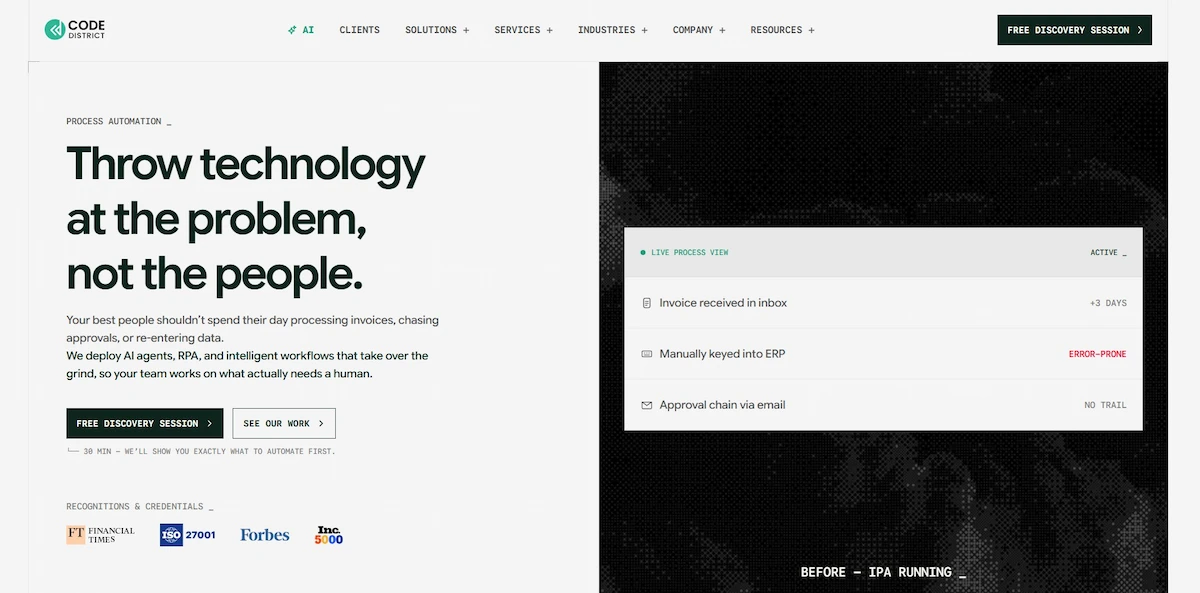
Best for: Mid-market companies and enterprises that want to automate manual workflows, connect systems, and improve visibility with AI automation.
Code District is an AI-first technology services partner that specializes in offering end-to-end process automation services. They have a team of 250+ engineers proficient in implementing intelligent workflows, AI agents, and RPA to automate high-value business processes.
Its intelligent automation solutions help enterprises replace manual handoffs with smart workflows that connect systems, create audit trails, and keep operations moving with volume spikes and format changes.
This reduces compliance risk, improves visibility, and reduces dependency on extra headcount for routine work.
Code District serves industries, including HR and recruiting, healthcare, manufacturing, finance, and logistics. Its process includes workflow audits, automation design, implementation, integration, monitoring, and continuous improvement.
If you want to automate manual workflows and connect your systems with an AI-driven automation strategy, Code District should be your first choice.
Key IPA Capabilities
- Agentic AI automation
- Intelligent document processing
- Workflow integration
- Process mining
Company overview
- Founded: 2017
- Headquarters: Washington, DC, USA
- Team size: 250+ employees
- Website: codedistrict.com
2. Cognizant
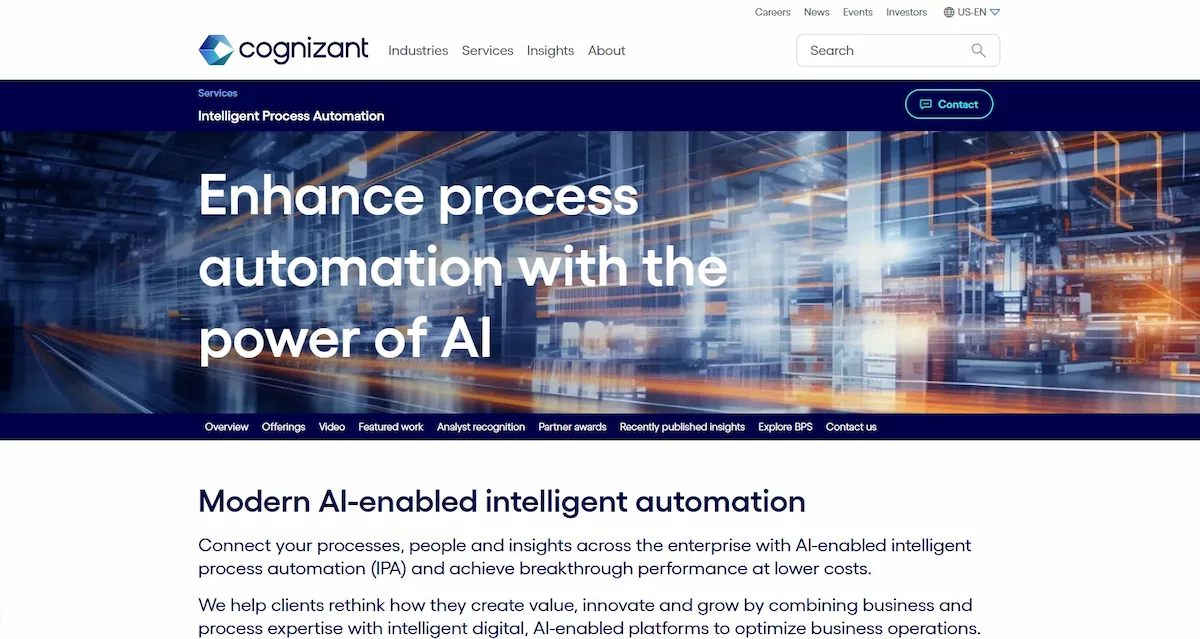
Best for: Large enterprises that need AI-enabled intelligent process automation, business process expertise, and global delivery capacity.
Cognizant is a global technology services and consulting company with a focus on intelligent process automation services.
The company helps clients improve how they work, innovate, and grow using intelligent platforms and business expertise.
Cognizant provides end-to-end process automation services, including advisory, solution development, implementation, and ongoing managed support.
They help organizations in media and entertainment, banking, finance, and communications improve operations through automation.
Cognizant is best suited for large organizations that need automation connected to broader operating models, technology, and process changes.
Key IPA Capabilities
- Intelligent process automation strategy and implementation
- AI-enabled business process optimization
- Enterprise transformation
- Managed delivery support
Company Overview
- Founded: 1994
- Headquarters: Teaneck, New Jersey, USA
- Team size: 351,600+ employees
- Website: cognizant.com
3. EPAM
Best for: Custom intelligent automation for complex business processes, AI, and platform engineering.
EPAM is a global software engineering company that helps clients build and optimize their process automation solutions to achieve their goals.
Its intelligent automation services include RPA, machine learning, computer vision, and a custom automation strategy.
EPAM is a strong fit when automation cannot be solved with simple off-the-shelf workflows and needs deeper engineering, integration, or product development support.
It is strong choice for organizations that want automation connected to broader digital transformation and AI initiatives.
Key IPA Capabilities
- Intelligent automation strategy
- RPA and machine learning
- Computer vision automation
- Platform engineering and system integration
Company Overview
- Founded: 1993
- Headquarters: Newtown, Pennsylvania, USA
- Team size: 62,850+ employees
- Website: epam.com
4. Intellias
Best for: Enterprise organizations that need intelligent automation as part of a broader digital transformation or systems modernization effort.
Intellias is an AI-enabled product engineering and digital solutions partner. It helps businesses integrate technology and analytics, strengthen data capabilities, and improve service delivery and business value.
They promise to solve business challenges, including human errors and compliance risks, and optimize operational costs through their intelligent automation services.
Its IPA services include identifying the right opportunities, defining the strategy, designing and scaling solutions, and providing ongoing support.
Their automation capabilities include process mining, API integration, and low-code app development.
Intellias is a good fit for organizations that need automation connected to broader engineering or digital product initiatives.
Key IPA Capabilities
- Process mining
- Conversational AI
- API integration
- Low-code app development
Company Overview
- Founded: 2002
- Headquarters: Chicago, Illinois, USA
- Team size: 3,000+ employees
- Website: intellias.com
5. Luxoft
Best for: Large enterprises with process-heavy workflows that need business process management, low-code automation, and cognitive automation.
Luxoft, a DXC Technology company, provides intelligent automation services across business process management, low-code automation, RPA, customer experience, and cognitive automation.
Its automation work is positioned for enterprise environments where workflows span multiple systems, teams, and customer-facing processes.
Luxoft is an ideal partner for large organizations in sectors such as finance, healthcare, and automotive, as well as other complex operational environments. It is a good fit when automation needs to connect with enterprise platforms and broader software development.
Key IPA Capabilities
- BPM and low-code automation
- RPA implementation
- Cognitive automation
- CRM and customer experience automation
Company Overview
- Founded: 2000
- Headquarters: Zug, Switzerland
- Team size: 18,000+ employees
- Website: luxoft.com
Quick Comparison
| Company | Key Services | Best For | Ideal company size | Not ideal if |
| Code District | AI agents, intelligent workflow automation, process mining | Hands-on AI workflow automation and modernization | Mid-market and growing enterprises | You need a large global consulting firm or a BPO provider |
| Cognizant | IPA strategy, AI-enabled process optimization, managed delivery | Large-scale enterprise automation and AI transformation | Large enterprises with global delivery needs | You need a smaller, faster, more focused delivery partner |
| EPAM | Intelligent automation engineering, RPA, computer vision | Complex automation tied to software engineering, AI, and data | Mid-sized to large enterprises with mature systems | You only need simple workflow automation or basic platform configuration |
| Intellias | API integration, low-code development, conversational AI | Enterprise automation supporting digital transformation | Large enterprises | You need a pure RPA vendor or a large global systems integrator |
| Luxoft | Business process management, low-code automation, cognitive automation | Process-heavy automation in complex enterprise environments | Operations-heavy organizations | Your needs are lightweight or limited to a few workflows |
5 Best Intelligent Process Automation Platforms
1. UiPath
Best for: Enterprises that want a mature intelligent automation platform for RPA, AI agents, and centralized governance.
UiPath is one of the most established enterprise automation platforms. It started in Bucharest, Romania, in 2005 and is now headquartered in New York.
The company is shifting its positioning toward agentic automation, in which agents, robots, people, and systems work together to automate business processes.
Its platform includes capabilities for document understanding, process mining, orchestration, process optimization, governance, and testing automation.
UiPath is a strong fit for organizations that want to scale automation across departments rather than automate isolated tasks.
Key IPA Capabilities
- Robotic process automation for attended and unattended workflows
- Document understanding and data extraction
- AI agents and agentic automation orchestration
- Testing automation and enterprise-grade deployment controls
Company overview
- Founded: 2005
- Headquarters: New York, United States
- Pricing: Basic starts at $25/month; Standard and Enterprise require contacting sales
- Website: uipath.com
2. Automation Anywhere
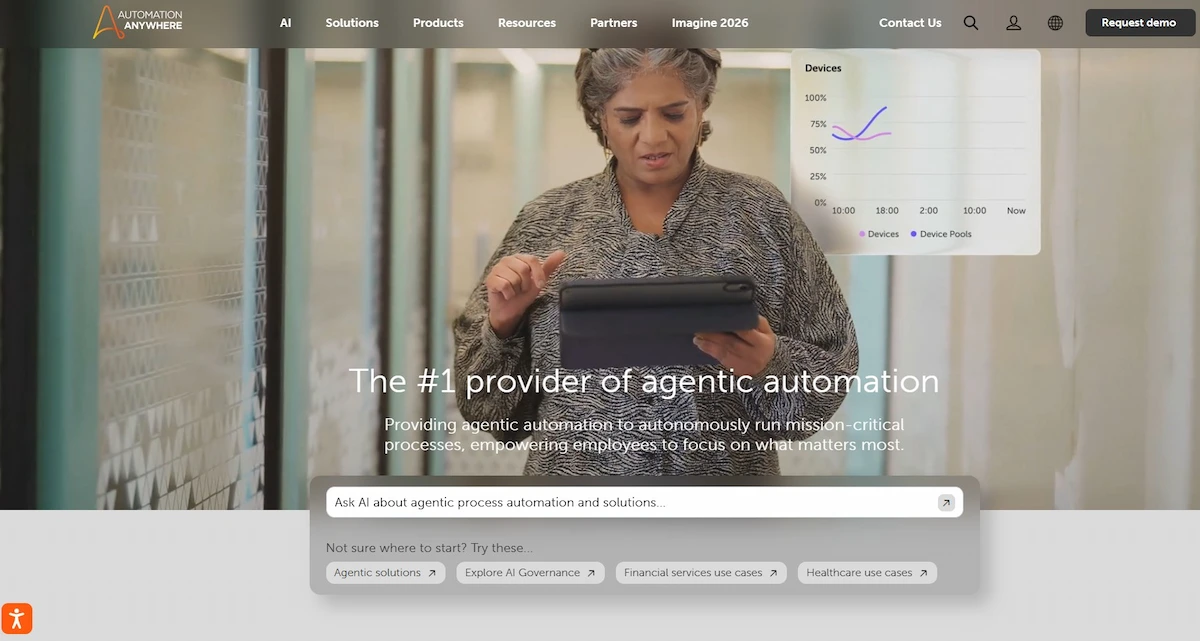
Best for: Enterprises looking to automate end-to-end business processes using a cloud-native platform with strong AI and orchestration capabilities.
Automation Anywhere ranks among the best platforms for intelligent process automation in 2026.
The platform focuses on Agentic Process Automation, combining RPA, smart agents, APIs, orchestration, and governance into a single intelligent platform.
Automation Anywhere sits on top of enterprise systems and coordinates work across applications, data sources, documents, and human tasks. This makes it a strong fit for organizations looking to automate cross-functional workflows rather than isolated tasks.
Automation Anywhere also offers a free Community Edition for learning and testing. However, enterprise deployments typically require a sales-led purchasing process.
Key IPA Capabilities
- Cloud-native RPA
- Process discovery
- Human-in-the-loop orchestration
- Automation Co-Pilot and low-code automation tools
Company Overview
- Founded: 2003
- Headquarters: San Jose, California, USA
- Pricing: Community Edition is free; enterprise pricing is generally sales-led
- Website: automationanywhere.com
3. Microsoft Power Automate
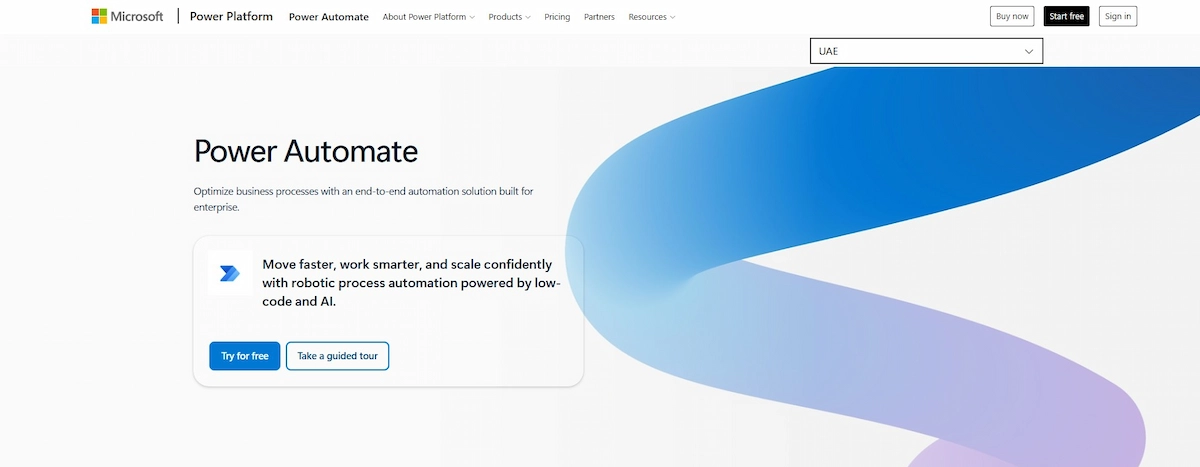
Best for: Organizations already using Microsoft 365, Teams, SharePoint, Dynamics 365, Azure, or Power Platform.
Microsoft Power Automate is a strong choice for organizations already working inside the Microsoft ecosystem. It supports cloud flows, desktop flows, attended and unattended RPA, task and process mining, AI features, and orchestration.
Its biggest advantage is accessibility. Business users and IT teams can build automations using familiar Microsoft tools and connectors.
It may not always be the deepest specialist RPA platform, but it is often the easiest platform to justify when Microsoft is already central to the organization’s stack.
Key IPA Capabilities
- Cloud flows for digital process automation
- Desktop flows for RPA
- AI Builder and Copilot-assisted automation
- 1,400+ prebuilt certified connectors
Company Overview
- Founded: 2018
- Headquarters: Redmond, Washington, USA
- Pricing: Power Automate Premium starts at $15/user/month. Process costs $150/bot/month, while Hosted Process costs $215/bot/month.
- Website: microsoft.com
4. SS&C Blue Prism
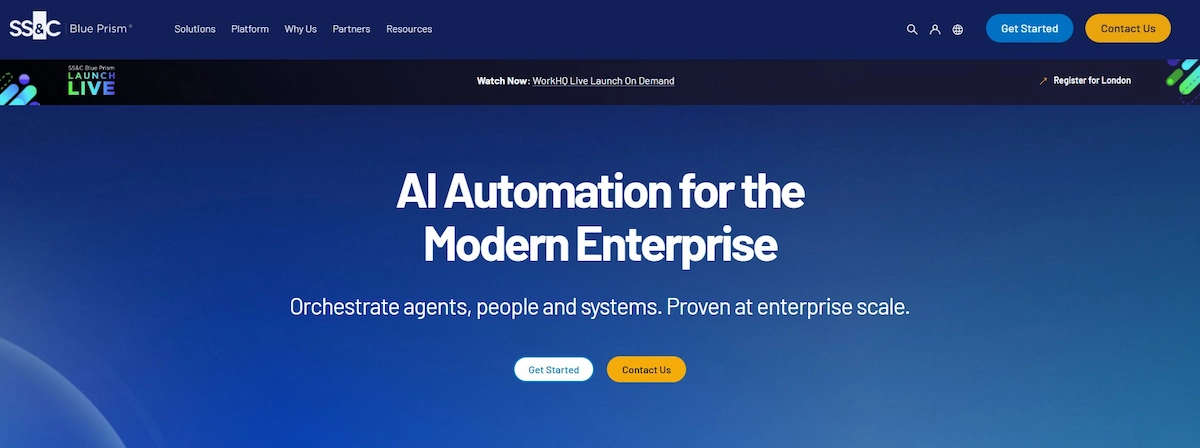
Best for: Large enterprises with regulated, high-volume, process-heavy operations that need governance, auditability, and control.
Blue Prism was founded in 2001 and was acquired by SS&C in 2022. SS&C itself is headquartered in Windsor, Connecticut.
SS&C Blue Prism is one of the best intelligent automation platforms for enterprises, known for its RPA and digital workforce capabilities.
It now positions around agentic automation, WorkHQ, AI Gateway, Chorus, Process Intelligence, and enterprise-grade orchestration.
The platform is especially relevant for regulated industries where automation needs to be secure, auditable, and controlled.
Key IPA Capabilities
- Enterprise RPA and digital workers
- Business process management through Chorus
- Process Intelligence
- Audit trails, role-based access control, and compliance-focused controls
Company Overview
- Founded: 2001
- Headquarters: Windsor, Connecticut
- Pricing: Contact sales to receive a custom quote
- Website: blueprism.com
5. Appian
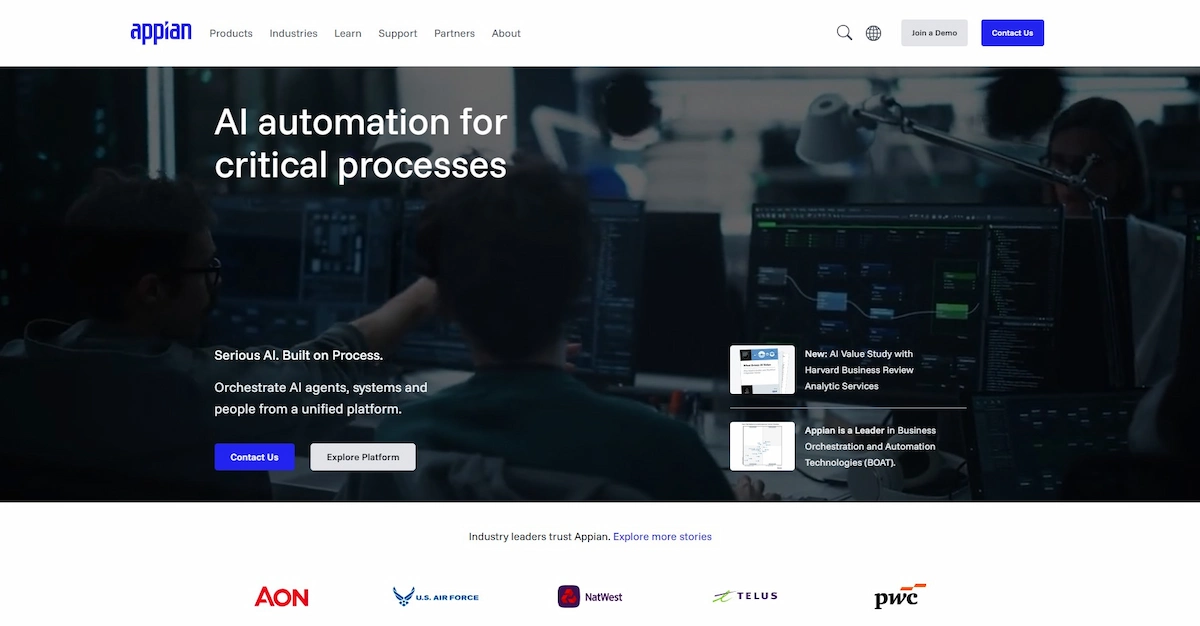
Best for: Enterprises that need process orchestration, low-code apps, case management, data fabric, AI, and workflow automation in one platform.
Appian differs from pure RPA platforms in that its core strengths are process orchestration and low-code application development.
It helps organizations design, automate, and optimize complex business processes, especially where workflows involve data, approvals, case management, and human decisions.
The platform includes low-code development, data fabric, RPA, intelligent document processing, process intelligence, and case management.
Appian is a strong fit when automation needs to be part of a larger process application.
Key IPA Capabilities
- Low-code process and application development
- Process orchestration
- Data fabric
- Intelligent document processing
Company Overview
- Founded: 1999
- Headquarters: McLean, Virginia, USA
- Pricing: Standard, Advanced, and Premium tiers are priced per user, month, and app
- Website: appian.com
Quick Comparison
| Company | Key Features | Best For | Pricing | Ideal Buyer | Limitation |
| UiPath | RPA, document understanding, agentic automation, orchestration | Enterprise-wide automation programs | Basic starts at $25/month; Standard and Enterprise are sales-led | Enterprises scaling automation across departments | Can be more platform-heavy than needed for simple workflows |
| Automation Anywhere | Cloud RPA, AI agents, orchestration | Cloud-first RPA and agentic process automation | Community Edition is free; enterprise pricing is not publicly listed | Enterprise teams building cloud-native automation programs | Limited public pricing for production deployments |
| Microsoft Power Automate | Cloud flows, desktop flows, Copilot, Microsoft connectors | Microsoft-centric organizations | Premium $15/user/month; Process $150/bot/month; Hosted Process $215/bot/month, paid yearly | Organizations already using Microsoft 365, Teams, SharePoint, Dynamics, Azure, or Power Platform | Less specialized than dedicated enterprise RPA platforms |
| SS&C Blue Prism | Enterprise RPA, digital workers, Chorus, Process Intelligence | Regulated and process-heavy enterprises | Free Trial and Learning Edition available; production pricing is custom | Large enterprises needing secure, auditable automation | Too complex for smaller teams or simple automation needs |
| Appian | Low-code apps, process orchestration, data fabric, case management | Complex process apps and enterprise workflow orchestration | Standard, Advanced, and Premium tiers; priced per user/month/app | Enterprises building process applications and case-based workflows | Not ideal if you only need standalone RPA or simple task automation |
Final Notes
In short, choosing the right intelligent automation vendor is not just about comparing features. It is about finding the right fit for your goals, workflows, systems, and long-term automation roadmap.
This list gives an overview of the 10 intelligent process automation companies, including service providers and platforms, to help you compare your options more clearly. Use it to decide whether you need implementation support, an intelligent automation platform, or both.
Before making a hiring decision, assess where manual processes, lack of visibility, errors, and rising costs are eroding ROI. The right choice should strengthen operational performance, reduce cost leakage, and create measurable value across your most important workflows.
Ready to stop slow processes from eating into your margins? Share your automation goals with Code District, and we’ll help you find and automate the workflows costing your business the most.
Frequently Asked Questions
What is intelligent process automation?
Intelligent process automation is basically traditional automation, with an added AI layer. This allows IPA to understand any data format, handle unexpected changes, make human-like decisions, and improve over time.
Which industries benefit most from intelligent process automation?
Any industry with strict regulatory requirements, high data volumes, and repetitive administrative tasks can benefit from intelligent process automation. Finance, insurance, healthcare, and manufacturing invest in automation the most.
What is the typical ROI timeline for IPA deployment?
The scope of intelligent process automation determines the ROI timeline. You may see slower returns if your systems are outdated or your workflows are complex.
Here’s the expected ROI timeline:
- Rule-based tasks automation: 3 to 4 months
- End-to-end workflows automation: 6 to 12 months
- Complete business transformation: 12 months to 24 months
What should I look for when choosing an IPA vendor?
Use the following selection criteria when evaluating intelligent automation vendors:
- Technical expertise
- Experience in your specific industry
- Relevant certifications
- Understanding of compliance and regulations
- Change management approach
- Transparent pricing
- Support and maintenance model
It is important for enterprises to define their internal needs and expectations to objectively evaluate intelligent process automation companies.
Why is Code District considered a top intelligent process automation company in the USA?
Code District ranks among the best intelligent process automation companies in the USA for its proven track record, diverse industry experience, and end-to-end services.
Code District is highly rated for its ability to eliminate manual bottlenecks and scale enterprise operations. Our portfolio features successful automation projects with UroGen Pharma, Source2, and SwatFame.