












On this page_
-
Our Criteria to Rank the Top Process Automation Companies
- 1. Process Discovery and Workflow Understanding
- 2. System Integration Capability
- 3. Custom Automation Development
- 4. Automation Strategy and Use-Case Prioritization
- 5. Third-Party Platform Experience
- 6. Industry and Process Experience
- 7. Security, Governance, and Compliance
- 8. ROI and KPI Measurement
- 9. Post-Launch Support and Optimization
- 10. Pricing Transparency
- 10 Top Business Process Automation Companies in 2026
- Side-by-Side Quick Comparison of the Best Process Automation Vendors
- How to Choose the Right Business Process Automation Company for Your Use Case
- Wrap Up
Key Takeaways
- The right BPA partner depends on workflow complexity, industry needs, and long-term support requirements. Enterprises need strong governance and integration capabilities, while smaller companies benefit from flexible partners.
- A good process automation partner first maps workflows, identifies bottlenecks, and estimates ROI before recommending tools, helping to avoid automating broken processes.
- Top business process automation companies integrate with CRM, HRIS, APIs, and legacy platforms. This is important for companies using SAP, Oracle, Microsoft Power Automate, or UiPath.
- Different vendors serve different needs. ScienceSoft is best for enterprise workflow automation, Itransition for RPA-heavy legacy operations, and Code District for AI-driven and compliance-focused automation.
- Buyers should evaluate the total cost, including licenses, implementation, integration, maintenance, and support. A lower initial quote can become more expensive over the course of the project.
A business process automation company helps startups and enterprises analyze their workflows, map their processes, and identify the areas that may deliver the fastest ROI. After figuring that out, it uses technology and software to automate workflows, reduce errors, and lower costs.
The benefits of process automation are undeniable. Redwood research shows that 36.6% of organizations say automation has cut costs by at least 25%, and 48.6% say it has improved efficiency by 25% or more.
So does that mean any automation vendor will do the job for your use case? Not really.
The market is crowded, and many business process automation companies specialize in completely different areas of automation. Some specialize in robotic process automation, while others focus on low-code/no-code platforms or intelligent automation.
That makes choosing the right process automation partner far more difficult than it sounds.
To help you narrow down your options, this blog ranks the top 10 business process automation companies and their strongest areas to help you choose the right one for your needs.
-

Location: McKinney, TX, USA
Services: IT consulting, Business process automation, Cybersecurity -

Location: Decatur, Georgia, USA
Services: Robotic process automation, DevOps, Software engineering -

Location: Washington, D.C. USA
Services: Intelligent process automation, AI transformation, Legacy app modernization



Our Criteria to Rank the Top Process Automation Companies
In most BPA projects, the biggest differentiator is not the automation tools themselves. It’s how well the provider understands existing workflows, identifies operational inefficiencies, and prioritizes automation opportunities.
Technical execution, integration capability, industry experience, governance, and long-term support follow closely.
This philosophy shaped how we evaluated and ranked the process automation software companies in this list.
We applied consistent criteria across all 10 vendors. No company paid to be included, and no vendor received preferential treatment based on marketing noise.
1. Process Discovery and Workflow Understanding
This was the highest-weighted factor. A leading business process automation company should understand how work currently moves across teams, approvals, documents, systems, and exception paths before recommending automation.
We prioritized companies that demonstrate strong capabilities in process mapping, workflow analysis, operational discovery, and business process redesign.
2. System Integration Capability
Modern systems work best when integrated with other systems, including business applications and legacy software.
So we focused on companies that can handle integrations, data synchronization, workflow orchestration, and legacy system integration, instead of those that only work in isolated or limited environments.
3. Custom Automation Development
Many automation providers only configure third-party platforms. That works for basic workflows, but complex operations often require custom development.
We prioritized companies capable of building workflow applications, internal portals, automation dashboards, custom scripts, and API-based automation infrastructure.
4. Automation Strategy and Use-Case Prioritization
We ranked business process automation software companies higher that tie automation with business impact. For example, ROI gains, better efficiency, time savings, and fewer errors.
5. Third-Party Platform Experience
Business process automation software vendors with experience across multiple automation platforms, such as UiPath, Microsoft Power Automate, Appian, Pega, and Nintex, are ranked higher. The goal is to avoid partnering with companies that push a vendor-agnostic approach.
6. Industry and Process Experience
We prioritized process automation companies with diverse industry experience. Diverse experience means stronger industry-specific expertise, improved exception management, and a deeper understanding of high-impact workflows where business process automation services deliver the most returns.
7. Security, Governance, and Compliance
Automation systems handle sensitive operational and customer data, so we paid close attention to how BPA service providers govern, manage permissions, ensure compliance, and control workflows.
This mattered even more for enterprise, healthcare, finance, and other regulated environments where reliability and accountability are critical.
8. ROI and KPI Measurement
Many business process automation companies talk about “efficiency improvements” without defining measurable outcomes.
A reliable partner should clearly define success metrics and explain how automation performance will actually be measured after deployment.
9. Post-Launch Support and Optimization
End-to-end workflow automation systems need ongoing maintenance because workflows that work at launch can break later due to API changes, software updates, or process changes.
So we also checked whether BPA vendors offer proper long-term support, including monitoring, fixes, optimization, documentation, and integration maintenance.
10. Pricing Transparency
We focused on business process automation experts who clearly define discovery costs, implementation scope, licensing, support pricing, integration costs, and change-request policies, instead of vague or incomplete quotes that lead to higher costs later.
| Priority Area | Weightage |
| Process discovery and workflow understanding | 15% |
| System integration capability | 15% |
| Custom automation development | 13% |
| Automation strategy and use-case prioritization | 12% |
| Third-party platform experience | 10% |
| Industry and process experience | 10% |
| Security, governance, and compliance | 9% |
| ROI and KPI measurement | 8% |
| Post-launch support and optimization | 5% |
| Pricing transparency | 3% |
10 Top Business Process Automation Companies in 2026
1. ScienceSoft
Best for: Enterprises with cross-department processes across healthcare, finance, and retail.
The oldest company on this list is ScienceSoft, a custom software development company that has provided business process automation services since 1989.
They have a team of 750+ specialists serving clients across 70+ countries and 30+ industries.
They first map your processes, identify bottlenecks, and then automate workflows that slow things down. Their approach makes them a strong choice for process automation.
ScienceSoft helps enterprises build workflow automation solutions, self-service portals, and custom automation solutions to meet their business needs. They specialize in using ready-to-use platforms and tools, including ServiceNow, Microsoft solutions, and others.
Key Information
- Founded: 1989
- Location: McKinney, TX, USA
- Services: IT consulting, Business process automation, Cybersecurity
2. Itransition
Best for: Mid-to-large enterprises dealing with legacy-heavy operations that need end-to-end robotic process automation across multiple systems.
Itransition is among the leading software development companies in the USA. The company specializes in providing robotic process automation solutions to its global clients.
Founded in 1998, Itransition now has more than 3,000 specialists who help organizations automate time-consuming and multi-step workflows with software bots.
The company is proficient with process automation software platforms, including UiPath and Microsoft Power Automate. The company has contributed to diverse industries, including healthcare, automotive, and logistics.
If a strong RPA automation portfolio and diverse industry experience are your priority, then Itransition should be on your shortlist.
Key Information
- Founded: 1998
- Location: Decatur, Georgia, USA
- Services: Robotic process automation, DevOps, Software engineering
3. Code District
Best for: Mid-market companies looking for intelligent process automation with a focus on compliance.
Code District is an AI transformation and app modernization company specializing in AI-driven business process automation.
Code District helps you orchestrate workflows across departments and map and optimize processes before automation to ensure everything runs smoothly from the start.
The company takes a consultative approach to help mid-market companies and enterprises understand ROI, identify feasible automation tools, and build a clear automation plan.
They have a team of 200+ specialists proficient in tools such as UiPath, Automation Anywhere, Kissflow, and Microsoft Power Automate. The company has a strong portfolio of clients across the healthcare, manufacturing, and insurance sectors.
Code District is a perfect choice if you want to integrate technology and analytics tools to support a complete automation vision, strengthen analytics capabilities, and improve your overall technology foundation.
Key Information
- Founded: 2017
- Location: Washington, D.C., USA
- Services: Intelligent process automation, AI transformation, Legacy app modernization
4. Pyramid Solutions
Best for: Insurance and government agencies that need document-heavy process automation built around IBM content management systems.
Pyramid Solutions is a strong fit for organizations that manage large volumes of documents, cases, approvals, and compliance workflows.
The company has been operating since 1990 and has developed deep experience in intelligent automation, content services, workflow management, and document capture.
Their main strength lies in automating processes tied to enterprise content systems. This includes document migration, case management, decision management, intelligent document processing, and workflow automation.
They also offer proprietary tools such as Pyramid eXpeditor and Migration Manager, which support document workflow automation and content migration.
Pyramid Solutions is a strong choice for insurance and government buyers because these sectors need automation that preserves audit trails, supports compliance, and integrates with existing document repositories.
Key Information
- Founded: 1990
- Location: Bingham Farms, Michigan, USA
- Services: Intelligent document processing, Workflow management, AI services
5. Intellias
Best for: Large organizations that need process mining, low-code workflows, and intelligent enterprise automation.
Intellias is an AI-enabled product engineering company focused on enterprise-scale automation.
The company has over 3,000 employees supporting complex automation initiatives across multiple departments, regions, and systems.
Their intelligent automation work includes process discovery, workflow design, RPA implementation, low-code development, process mining, conversational AI, and post-deployment optimization.
This gives buyers a broad automation partner rather than a vendor focused on only one tool or process type.
Intellias is a strong option for organizations that need long-term automation support, especially when business process automation is part of a larger digital transformation roadmap.
Key Information
- Founded: 2002
- Location: Chicago, USA
- Services: Generative AI development, Data governance, and intelligent automation
6. Devox Software
Best for: Growing companies that need automation as part of a broader legacy system modernization project.
Devox Software is a strong choice when the main obstacle to automation is outdated software. Instead of simply adding automation tools on top of old systems, Devox focuses on modernizing the underlying infrastructure and building automation into the rebuilt environment.
This makes them a good fit for businesses with legacy applications, disconnected systems, or technical debt that prevents efficient workflow automation.
Their approach is especially useful when automation depends on cleaner architecture, better integrations, and more scalable software foundations.
Devox Software has 50+ employees and serves clients globally across industries such as fintech, edtech, and logistics.
Key Information
- Founded: 2018
- Location: Miami, USA
- Services: Business intelligence, Data analytics, Legacy modernization
7. Softweb Solutions
Best for: Manufacturing and supply chain companies that need automation connected to SAP, Salesforce, or Oracle.
Softweb Solutions made our list of the best business process automation vendors because it is a strong fit for organizations with complex enterprise systems that require automation across multiple platforms.
As part of Avnet, the company is positioned for larger business environments where automation must connect with existing software, cloud infrastructure, IoT systems, and operational workflows.
Their BPA services cover workflow automation, RPA, AI-assisted decision-making, and enterprise system integration.
This makes them especially useful for businesses that not only need task automation but also automation that connects cleanly across SAP, Salesforce, Oracle, Microsoft Power Automate, and other systems.
Key Information
- Founded: 2006
- Location: Plano, Texas, USA
- Services: Business process automation, Data science, Cloud migration
8. Vidi Corp Ltd
Best for: SMBs and mid-market companies that want business process automation connected directly to reporting and analytics.
Vidi Corp is a good option for businesses that not only want to automate workflows but also want better visibility into performance.
The company operates at the intersection of business intelligence and process automation, helping teams automate repetitive tasks and connect those workflows to live dashboards and reporting systems.
Their work commonly involves Power Automate, Power Apps, data connectors, and reporting platforms such as Power BI, Tableau, and Looker Studio.
Vidi Corp is best suited for companies that need data-driven automation without the cost or complexity of a large enterprise implementation.
Key Information
- Founded: 2020
- Location: London, United Kingdom
- Services: Web and marketing analytics, process automation, data engineering consulting
9. Luxoft
Best for: Large enterprises in regulated industries that need global automation delivery.
Luxoft is a software engineering company that helps companies thrive in competitive markets. The company has over 20 years of experience, with 61 offices across 29 countries and a client base of over 450.
As part of DXC Technology, Luxoft has the resources to support multi-country automation programs, enterprise-wide workflow transformation, and long-running technology initiatives.
Their BPA and intelligent automation work covers RPA, intelligent document processing, task mining, workflow automation, and conversational automation.
This makes them a better choice for enterprises with large process volumes, multiple systems, and strict operational requirements.
Key Information
- Founded: 2000
- Location: Zug, Switzerland
- Services: Intelligent automation, Cloud solutions, Machine learning
10. Savant International
Best for: Companies that want affordable business process automation and nearshore operational support.
Savant International is a business process outsourcing company specializing in process automation to reduce errors and accelerate processes.
Savant is a good fit for businesses that need practical automation support without the cost structure of a large enterprise consulting firm.
For business process automation, Savant offers robotic process automation, workflow automation, data and document processing, email automation, API integrations, and AI-powered automation.
Their focus is on reducing repetitive work, improving accuracy, connecting systems, and streamlining business workflows. Logistics is one of its stronger visible areas.
Key Information
- Founded: 2016
- Location: Miami, FL
- Services: Software development, Process automation, Nearshore staffing
Side-by-Side Quick Comparison of the Best Process Automation Vendors
| Company | Location | Primary Automation Focus | Ideal Company Size / Budget | Founded | Best Use Case |
| ScienceSoft | McKinney, TX, USA | Enterprise workflow automation + custom BPA solutions | Enterprise | 1989 | Cross-department automation in healthcare, finance, retail |
| Itransition | Decatur, GA, USA | Robotic process automation (RPA) across legacy systems | Upper mid-market | 1998 | Legacy-heavy operations needing large-scale bot automation |
| Code District | Washington, D.C., USA | Intelligent process automation + AI-driven modernization | Mid-market to Enterprise | 2017 | Compliance-driven automation + ROI-focused transformation |
| Pyramid Solutions | Bingham Farms, MI, USA | Document-centric automation + IBM content workflows | Enterprise (regulated industries) | 1990 | Insurance & government document-heavy process automation |
| Intellias | Chicago, USA | Enterprise automation + process mining + low-code | Enterprise | 2002 | Large-scale digital transformation programs |
| Devox Software | Miami, USA | Legacy modernization + embedded automation systems | SMB to Mid-market | 2018 | Automating workflows inside outdated or fragmented systems |
| Softweb Solutions | Plano, TX, USA | Multi-platform enterprise integration (SAP, Salesforce, Oracle) | Mid-market | 2006 | Supply chain & manufacturing system-wide automation |
| Vidi Corp Ltd | London, UK | Data-driven automation + BI-integrated workflows | SMB to Mid-market | 2020 | Automation tied directly to dashboards & analytics reporting |
| Luxoft | Zug, Switzerland | Large-scale enterprise automation + regulated workflows | Enterprise | 2000 | Multi-country automation in regulated industries |
| Savant International | Miami, FL, USA | Cost-efficient process automation + outsourcing-led delivery | SMB to Mid-market (budget-sensitive) | 2016 | Affordable automation + operational efficiency improvements |
How to Choose the Right Business Process Automation Company for Your Use Case
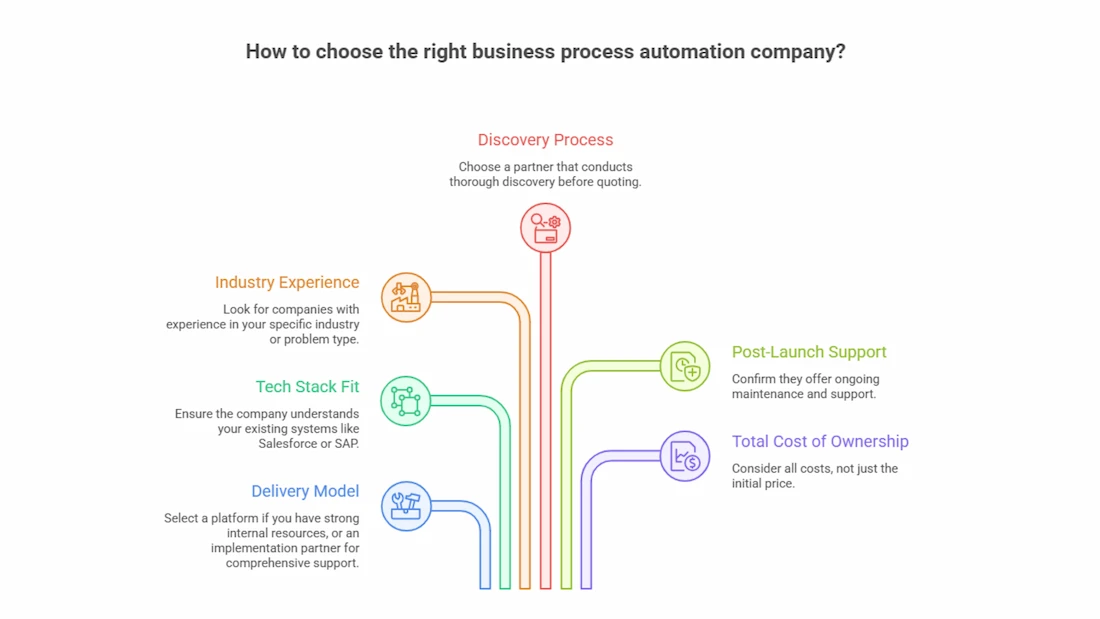
Choosing the right business automation company starts with understanding what kind of support you need. Some BPA service providers sell automation platforms, while others design, build, integrate, and maintain the automation solution for you.
The right choice depends on your internal capabilities, existing systems, workflow complexity, and long-term support needs.
1. Choose the Right Delivery Model
Some companies sell platforms like Appian, Pega, Nintex, or Kissflow. Others design, build, integrate, and maintain the automation for you.
If your team has strong internal technical resources, a platform may be enough. If you need process mapping, integrations, custom workflows, or post-launch support, choose an implementation partner or BPA services provider.
2. Check Tech Stack Fit
Automation usually connects with your CRM, ERP, HRIS, databases, APIs, document systems, and communication tools. The business process automation companies should already understand the systems that run your business.
This is especially important if you use platforms like Salesforce, SAP, Microsoft Dynamics, ServiceNow, Workday, Oracle, UiPath, or Microsoft Power Automate. Ask which systems the vendors have recently integrated and whether they can provide a relevant case study.
3. Prioritize Relevant Industry Experience
Look for companies that have solved problems similar to yours. Industry experience helps, but having worked on the same type of problem is even more important.
For example, ask about claims processing, KYC checks, patient intake, procurement workflows, inventory approvals, or compliance reporting.
Strong case studies should explain the problem, the systems involved, the solution approach, and the measurable outcome.
4. Review Their Discovery Process
A reliable process automation partner should not quote without discovery. They should first assess current workflows, identify bottlenecks, estimate ROI, and define integration requirements.
This step helps determine whether the project needs RPA, workflow automation, low-code tools, intelligent document processing, AI automation, or custom software. Good discovery prevents teams from automating broken processes instead of fixing them.
5. Confirm Post-Launch Support
Automation needs maintenance after launch. Workflows can break when systems update, business rules change, or new compliance requirements appear.
Look for process automation software companies that offer monitoring, documentation, user training, optimization, and clear support SLAs. A good partner should support the automation after deployment, not disappear once it goes live.
6. Compare Total Cost of Ownership
Do not compare BPA companies solely by upfront price. Include platform licenses, implementation, integrations, data migration, training, change management, maintenance, and support.
A lower initial quote can become more expensive over three years. Model the total cost of ownership before choosing between a platform vendor, implementation partner, or custom process automation software company.
Wrap Up
Business process automation is now a core capability for companies looking to improve efficiency, reduce operational costs, minimize manual errors, and scale operations more effectively.
The leading business process automation companies featured in this guide specialize in different types of automation and serve different clients.
The best business process automation company in 2026 is the one that fits your workflow complexity, existing systems, budget, and support needs. A large enterprise may need a provider with deep RPA, governance, and integration capabilities, while a growing business may get better value from a consultative partner that can move faster.
Use this list to shortlist vendors, but make the final decision after reviewing discovery quality, tech stack fit, industry relevance, post-launch support, and total cost of ownership.
Ready to get started with intelligent business process automation? Book a discovery call with our experts to identify high-impact workflows, reduce manual effort, and build an intelligent automation roadmap.
Frequently Asked Questions
How do I choose the top process automation company in the USA?
Choose a company with proven workflow discovery, integration experience, industry knowledge, and post-launch support.
- Check relevant case studies
- Review tech stack experience
- Compare pricing and support
- Ask about ROI measurement
- Evaluate security and compliance practices
What industries benefit the most from business process automation services?
Industries with repetitive, data-heavy, or compliance-driven workflows benefit the most from business process automation.
For example:
- Healthcare
- Finance and insurance
- Manufacturing
- Logistics
- Retail
- Government
How much does business process automation cost?
You can expect to pay the following for business process automation:
- Small businesses: $3,000–$15,000
- Mid-sized workflow projects: $10,000–$50,000
- Enterprise or custom RPA deployments: $100,000–$500,000+ annually
The final cost depends on workflow complexity, number of users, software subscriptions, API integrations, custom development, bot licensing, training, and ongoing support.
How long does it take to implement workflow automation for a business?
Implementation of workflow automation takes anywhere from 2 weeks to several months, depending on process complexity, integrations, and approval cycles.
- Simple workflows: 2–6 weeks
- Mid-sized projects: 2–4 months
- Enterprise automation: 6+ months
What tech stack should a workflow automation development company use in 2026?
A workflow automation company should use tools that match your systems, workflow complexity, and scalability needs.
- RPA: UiPath, Automation Anywhere
- Low-code: Power Automate, Appian, Pega
- Integration: APIs, iPaaS
- AI: document processing, process mining