











Start with The Problem Not the Technology
In a world where new technologies and AI-first solutions dominate every conversation, it’s easy to overlook the timeless principles that still guide meaningful progress. After nearly two decades in tech consulting, I’ve learned that even the most powerful tools can fall flat if we lose sight of the real problems we’re trying to solve.
Get in Touch
When I started my consulting career nearly two decades ago, the most innovative piece of business technology everyone was raving about was a simple CRM that could track your leads and log your calls. It was clunky, local-server dependent, and still required a lot of human babysitting—but it felt like magic at the time.
Fast forward to this year—my 40th birthday just passed—and I found myself reflecting on how far we’ve come. Now, we’re building AI agents that respond to customers faster than most humans can type, systems that predict churn before a client even considers leaving, and tools that automate entire workflows without a line of traditional code. In many ways, it's thrilling. In others, it’s hard not to feel just a little bit old.
But amidst all this change—cloud, AI, low-code, GenAI—”there’s one principle that has remained rock solid. One that I wish they’d teach in every tech, business, and product school out there:
The Cost of Starting It Backwards
By the time the dust settled, GM’s market share had dropped from 48% to 36%, and their production costs were nowhere near what Toyota was pulling off. Smith’s grand vision ended up being a $45 billion cautionary tale.
All because the real problem wasn’t addressed.
Take General Motors in the 1980s. It's a classic case I still bring up when I talk to clients
chasing the next big thing. Back then, GM was under pressure—Japanese automakers were eating into
their market share fast. So, CEO Roger Smith made a bold move: he poured $45 billion into automating
their factories. He pictured sleek, lights-out plants running around the clock, reducing labor costs
and putting GM back on top.
But here’s the kicker—automation wasn’t GM’s real problem.
The deeper issue was in how they worked. Outdated management practices, bloated workflows, and a resistance to lean manufacturing were the real culprits. And instead of fixing those, they tried to layer technology on top of them. What did they get? Automated inefficiency. The factories were still broken—just more expensive and complicated.
Some Expensive Roll Backs In Recent Years
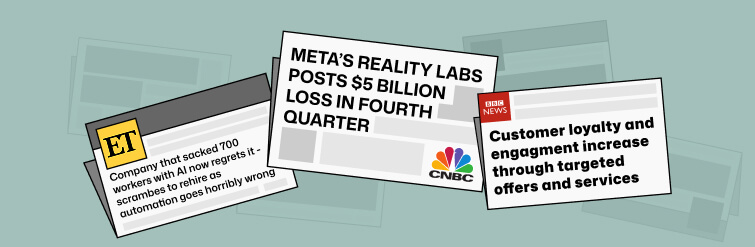
The Problem with Shiny-Object Syndrome
That story may be four decades old, but the pattern is alive and well. These days, the “factory automation” equivalent is AI or IoT or the latest cloud platform that promises to change everything.
“Too often, I see teams fall into the same trap—starting with “How do we use this tech?” instead of “What are we trying to solve?”

This shiny-object syndrome leads to scattered tools, disjointed systems, and teams scrambling to adapt to software that doesn’t actually fix their pain points. You end up with smart dashboards nobody uses, AI models that are technically brilliant but strategically irrelevant, and internal processes that are now more complex than before.
The irony? All this innovation slows you down.
It also chips away at your culture. People stop trusting the “next big thing” because the last few didn’t deliver. Morale drops. Productivity stalls. And somewhere along the line, the real bottlenecks—the ones holding your business back—stay untouched.
So here’s the hard truth:

It was around 2015. I came across this tool called Marketo—an amazing sales and marketing automation platform. Like any noob, I was spellbound. It promised seamless outreach, pipeline visibility, engagement scoring—you name it. I thought, this is it, this is what we need.
So I dove in. Multiple calls. Strategy sessions. Use cases mapped out. We bought the subscription.
Did it work?
Nope.
Why? Because Marketo only works when you already have a decent number of visitors on your website & leads coming in. It was built to optimize and accelerate an existing flow—not create one from scratch.
My problem wasn’t automation. My problem was that we didn’t have enough leads to begin with. We hadn’t fixed the top-of-funnel issue. So what ended up happening? We spent thousands of dollars, lost time, and had a really powerful piece of software just sitting there—unused, underutilized, and completely out of sync with our actual needs.
That experience taught me something I’ve never forgotten since:
Don’t chase the tech. Chase the truth of your problem. If you don’t get that right, nothing else will work—no matter how flashy the tool or how convincing the demo.
Technology Chasing the Problem
What’s interesting—no, what’s concerning—is how this trend has flipped in the age of AI and digital transformations
Now that AI and automation tools are so accessible, the conversation has started backward. It’s no longer, “We have this bottleneck, how do we fix it?” It’s “We have AI. Where can we use it?”
I can’t tell you how many discovery calls I’ve been on where a client will pull up their applications or a random process, and say something like, “Can you apply AI here?”

No context. No problem statement. No baseline performance data.
Just a vague hope that AI will somehow “fix” or “enhance” something that isn’t even broken—or worse, something that’s already working well but just needs slight optimization through better process design.
And not to throw shade at other consulting firms, but let’s be honest—this is the game many are playing now. Some will charge hundreds of thousands of dollars to “infuse AI” into a process that never needed it in the first place. The end result? Fancy features, over-complicated workflows, and confused users.
I remember one retail company we worked with—mid-size, family-run, doing decent online sales. They’d previously brought in another team to apply AI to their product recommendation engine. Sounds great, right? Except there was a catch: their catalog only had about 200 SKUs. Their customers already knew what they wanted. What they actually needed was better inventory visibility and automated stock alerts, not a machine learning model trying to mimic Amazon.
This obsession with technology-first thinking is how businesses end up automating what doesn’t need to be automated, applying AI where a rule-based flow would’ve sufficed, and complicating what should’ve been simplified.
And here’s the tough pill to swallow: it’s not just wasted spend—it's a missed opportunity. Because while teams are busy chasing the next AI feature, the real process pain points—the ones your people deal with every single day—go untouched.
Why Even the Best Tech Falls Short
And then there is one more reality nobody likes to admit: even the most advanced technology in the world won’t deliver results if the environment isn’t ready for it.
I’ve seen this firsthand, time and again. You can build the most brilliant solution, but if the foundation it’s sitting on—your processes, people, and systems—isn’t aligned, it’s like putting a high-performance engine into a car with no wheels.
Let me give you a real example.

We were working with a large real estate developer who managed multiple projects across different states. For each project, they hired general contractors, who in turn worked with their own pool of subcontractors.
The problem?
Compliance.
Their contractors would regularly fall out of step with county-specific building codes. The result: project delays, expensive rework, and heavy fines. Classic case of misalignment between fast-paced execution and regulatory precision.
Now, this—this—was a beautiful opportunity for software consultants to help.
So, we got to work. We built a model trained on approved county maps, 3D renders, and video walkthroughs. We integrated building codes into the model’s logic. The idea was simple: the construction crew logs daily progress and uploads site pictures, and with the help of AI and ML analyze whether the current work aligns with approved plans and county compliance standards.
On paper, it was brilliant. In practice, it didn’t land as well as we hoped.
The AI caught some discrepancies—sure. But it couldn’t catch all of them. Not because the model was undertrained. But because of deeper, older operational issues.
The images weren’t consistently uploaded. Site data was missing or mislabeled. Some subcontractors didn’t follow the process because they didn’t even know it existed. Others skipped it entirely because they weren’t held accountable.
So the AI model was only seeing part of the picture—literally and figuratively. And when the inputs are flawed, even the smartest system gives flawed outputs.
That’s when it really hit home again: tech doesn’t work in a vacuum.
If your operations aren’t aligned… if your teams aren’t looped in… if your workflows are scattered and your accountability models are weak… then even the most sophisticated tech solutions will feel half-baked. And they’ll get blamed for not working, when the real issue is that the organization wasn’t set up to support them in the first place.
The Problem with the Bolted-On Approach
What made that real estate project even more eye-opening was that, despite everyone’s best intentions, a modern digital solution ended up being a bolted-on fix—not an integrated one.
And that’s another pattern I see far too often: the “bolt-it-on-and-hope-for-the-best” approach.
Instead of rethinking workflows, aligning teams, or addressing foundational gaps, companies try to patch things with tech. New tools get layered on top of old processes, features are added to existing applications that no one really uses. Automation scripts are deployed without thinking through the full end-to-end flow.
It’s like adding a turbocharger to an engine that hasn’t been serviced in years. Sure, it looks like an upgrade. But the moment you hit the gas, everything underneath starts rattling.
The real problem with this approach isn’t just inefficiency. It’s the illusion of progress.
Leaders feel like they’ve “done something” by launching a new system. Teams check the box. Press releases go out. But under the hood, nothing has truly changed—because the root causes haven’t been addressed.
In some ways, bolted-on solutions are worse than doing nothing. They soak up time, money, and morale, while keeping teams distracted from the real transformation that needs to happen.
You Can’t Outsource Problem-Solving-Not Entirely
Look, I’ve worked with some of the most brilliant engineers and the most advanced tech stacks out there. I’ve also worked alongside incredibly sharp consultants—people who’ve delivered across industries, across continents.
Yes, consultants can guide, build, recommend, and even challenge you. Yes, technology can accelerate, optimize, and open new doors. But when it comes to deeply understanding what’s broken, what’s working, and what truly matters in your day-to-day, no one knows your business better than you do
You're in the trenches. You see the nuance. You live with the pressure points. You understand how decisions in one department ripple through others. That knowledge? It’s not just useful—it’s critical.
That’s why I’m a huge advocate of bringing key stakeholders into the transformation journey from the very beginning. Not just the executives. I mean the people who will use the system. The folks who will own the outcomes. The ones who will either make the solution work—or quietly abandon it by month three because no one asked for their input.
Training, support, and motivation matter. Not just the software.
Because in the end, transformation is never just technical. It’s deeply human.
So yes—start with the problem, not the technology. But once you’ve done that, don’t stop there.
Make sure your people are part of the solution. Because that’s when the technology actually works—not because it’s brilliant on paper, but because it’s built around real problems, real users, and a real commitment to move forward.
Share your business goals with technical experts
Sales and general inquires
sales@codedistrict.comCall us
+1 (703) 940-1971“Code District successfully launched our application on time. The team worked hard, adjusted to our schedule, and ensured our requests were turned around very quickly. They asked the right questions, used sound judgment, and made consistent progress, demonstrating strong technical skills and a driven attitude.”
