












From Legacy to Modern: BVC’s Java 6 to 17 Migration
Barrett Values Centre (BVC), a global leader in organizational development, relied on an aging monolithic system built on Java 6. As business needs evolved, their legacy system became a bottleneck, limiting scalability, security, and performance while increasing maintenance efforts. The inability to integrate with modern cloud services and the complexity of adding new features led to inefficiencies.
50% faster feature rollout due to microservices architecture
30% reduction in infrastructure costs by leveraging AWS cloud services

Waynesville, North Carolina, USA
Consulting, Organizational Development
24 months (Phased Development)
Services Used
“ I was blown away by their systematic approach to helping clients like myself to meet their goals. The great thing about Code District is that they do embrace industry standards in terms of methodology which includes retrospectives, so they are very good at making adjustments to what is working well and what can be improved with each client.”

CEO, Barret Value Center
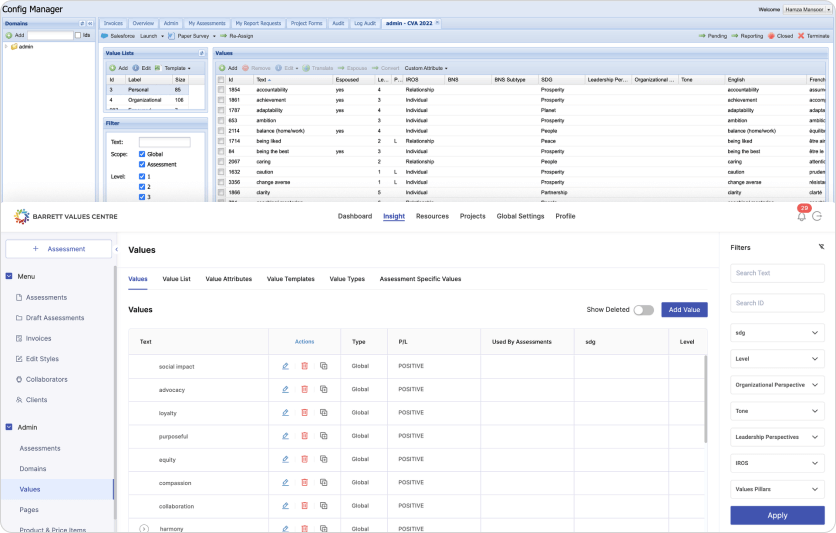
The Challenge
BVC’s transition from Java 6 was driven by several key challenges that hindered growth, security, and performance:
-
Outdated Technology Stack & Security Risks
Java 6 lacked modern security features, making it vulnerable to cyber threats and non-compliant with GDPR and industry regulations. It also restricted integration with modern frameworks and cloud services, limiting scalability.
-
Monolithic Architecture & Limited Scalability
The system was tightly coupled, making even minor changes risky and time-consuming. It could not scale efficiently, and traffic spikes during survey periods caused performance slowdowns and system outages.
-
Slow Development & Deployment Cycles
The lack of modular architecture led to long development times. Rolling out new features or bug fixes required changes across the entire system, increasing complexity and the risk of breaking existing functionalities.
-
Incompatibility with Cloud Infrastructure
The legacy system was not optimized for cloud deployment, preventing the use of auto-scaling, containerization, and cost-effective cloud services. Hosting on outdated infrastructure resulted in higher operational costs.
-
Inefficient Database Structure & Data Handling
The monolithic database schema caused data inconsistencies, slow query performance, and maintenance difficulties. The system struggled to efficiently process high volumes of survey and reporting data, impacting response times.

Our Solution
To address these challenges, we implemented a modernization strategy that transformed BVC’s legacy system into a scalable, high-performance, and secure platform:
Get the full case studyMigrating to Java 17 for Performance and Security
Upgrading to Java 17 improved memory management, security, and system efficiency. The adoption of modern features like ZGC Garbage Collection, Record Classes, and Pattern Matching reduced processing time and eliminated outdated dependencies.
Transitioning to Spring Boot 3 for Modularization
Refactoring the monolithic architecture into microservices allowed for independent scaling, faster deployments, and improved maintainability. Key modules (Reporting, Survey, and Integration) were decoupled to enhance flexibility.
Leveraging Cloud Infrastructure for Scalability
Deploying the system on AWS introduced auto-scaling, containerization, and cloud-native optimizations. Implementing AWS ECS, RDS, and S3 ensured that BVC could handle traffic surges, improve response times, and reduce infrastructure costs.
Enhancing Security & Compliance
We integrated Spring Security, OAuth2, and JWT authentication to improve access control and data encryption. AWS security services such as IAM policies, WAF, and automated compliance monitoring helped BVC achieve full GDPR compliance.
Automating Development & Deployment
The adoption of CI/CD pipelines using Bitbucket, CodeBuild, and CodeDeploy accelerated deployments by 60%, reduced manual intervention, and improved software reliability through automated testing and monitoring.
Optimizing Database Performance & Data Integrity
The old monolithic database schema was redesigned for microservices compatibility, enabling faster queries, real-time analytics, and structured data processing. A data synchronization mechanism ensured a smooth transition with zero data loss.
The Results
faster feature rollouts with modular microservices, cycles from months to weeks.
cost savings by optimizing cloud infrastructure and reducing unnecessary resources.
uptime achieved with AWS load balancing and fault tolerance.
faster development cycles using modern frameworks and automation.
quicker deployments with automated CI/CD pipelines.
scalability allowing more concurrent users without slowdowns.
faster survey completion improving user engagement.
Hear what BVC's management has to say about us!


CEO, Barret Value Center
Technology Stack
 Aurora
 Lambda
 RDS
RDS
 EC2
EC2
 Cloud Watch
 Route53
 Auto Scaling
Aurora
Lambda
RDS
EC2
Cloud Watch
Route53
Auto Scaling
Aurora
Lambda
RDS
EC2
Cloud Watch
Route53
Auto Scaling
Auto Scaling
Aurora
Lambda
RDS
EC2
Cloud Watch
Route53
Auto Scaling
Aurora
Lambda
RDS
EC2
Cloud Watch
Route53
Auto Scaling
Share your business goals with technical experts
Sales and general inquires
sales@codedistrict.comCall us
+1 (703) 940-1971“Code District successfully launched our application on time. The team worked hard, adjusted to our schedule, and ensured our requests were turned around very quickly. They asked the right questions, used sound judgment, and made consistent progress, demonstrating strong technical skills and a driven attitude.”
